The Boy Who Sent Martin Buber a Birthday Gift, and Was Later Murdered in Auschwitz

A letter and drawings sent by the young Wolfgang Steinitz to Martin Buber in honor of his sixtieth birthday reveal the rare talent and sensitivity of its creator whose life was cut short.

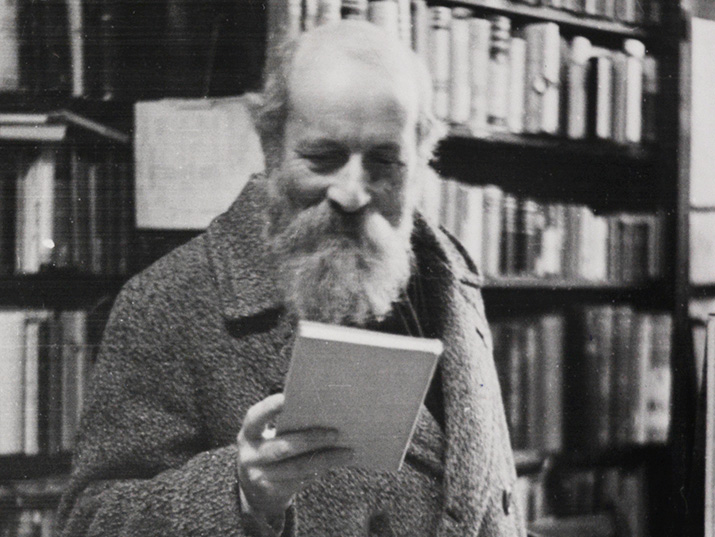
Martin Buber in the “He-Atid” bookstore in Jerusalem, 1946

While searching for documentary material about my family in the National Library’s archives in Jerusalem, the title “Letter by Wolfgang Steinitz to the Philosopher Prof. Martin Buber” came up.

The Wolfgang Steinitz in our family was an anthropologist, linguist and well known communist in Germany. I imagined that it was entirely possible that he had corresponded with Buber. Curious to know what the linguist and the famous Zionist philosopher had in common, I asked the archivist to see the letter. About an hour later the file from the Martin Buber archive with the letter was delivered to me.

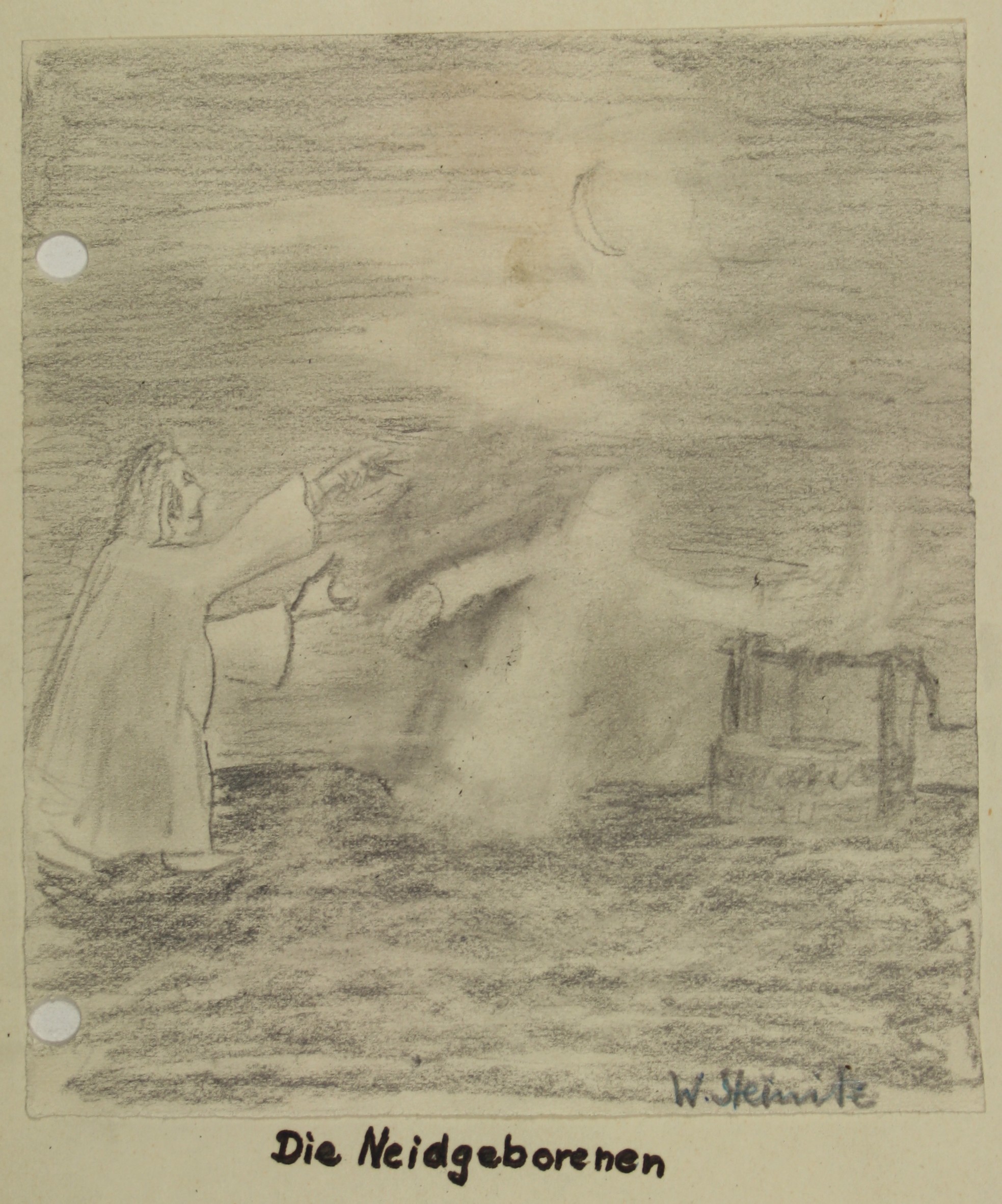
I opened the envelope, which was missing the sender’s address, and pulled out an undated letter obviously written in a child’s handwriting, and again without the address of the sender. Attached to the letter were three pages containing drawings.
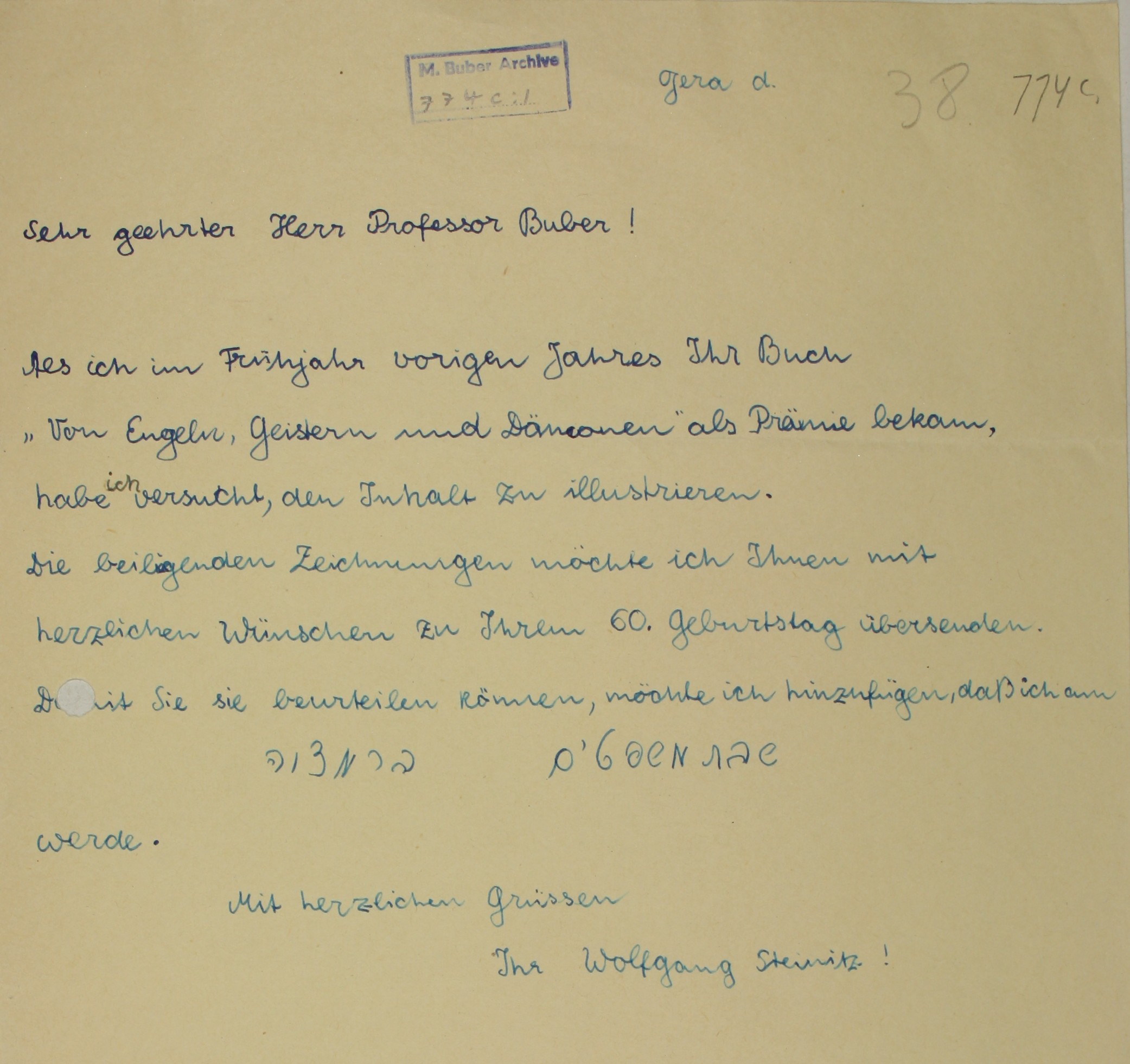
 

Following is my translation of the letter:

Very Distinguished Professor Buber!

After receiving your book Erzählungen von Engeln, Geistern und Dämonen (Tales of Angels Spirits & Demons) as a prize in the spring of last year, I tried to illustrate the contents. I am sending you the attached drawings along with wishes for your 60th birthday. So that you can appreciate them, I wish to note that I will celebrate my bar mitzvah on Shabbat (and will be reading from the Torah portion known as) Mishpatim.

With heartfelt wishes,

Wolfgang Steinitz
The letter’s content did not fit with the Wolfgang Steinitz from our family, who was twenty-seven years younger than Buber and would no longer have been a boy on Buber’s sixtieth birthday on February 8, 1938. What’s more, knowing our family history, it was not likely that our Wolfgang would have celebrated his bar mitzvah. And yet, I hoped that perhaps I had come across an unknown family mystery. I sent a picture of the boy’s letter to Wolfgang’s daughter in Berlin, with whom I am in contact, and asked her whether her father drew as a child and whether he had had a bar mitzvah. She answered in the negative to both questions.

I also searched for the book the boy had referred to in his letter to Buber. The entire book is devoted to stories of Hasidic rabbis, towns and courts, and is written in an archaic and not easy-to-read style.

As I followed various avenues of inquiry, my daughter asked me: “Have you tried searching in Yad Vashem?”


I hadn’t even considered Yad Vashem (Israel’s Holocaust memorial)… but I immediately wrote them and not long after received the chilling reply.

Piecing together the information from Yad Vashem, the boy’s bar mitzvah Torah portion and the date of Buber’s sixtieth birthday, I concluded that the writer of the letter was a boy from the city of Gera, near Leipzig, who sent Buber the drawings when he was thirteen years old. He was murdered in Auschwitz when he was all of nineteen.

I wrote about my findings to the Yad Vashem Art Museum and asked whether they were interested in the drawings and perhaps had additional drawings by this boy in their collection. I did not receive a response. I was left with the story which I reveal here for the first time.

I believe that the drawings that have been preserved in the archive for almost eighty years should be published in some way, both for the skill of the illustrations and the possibility that exposing them may lead to other works coming to light by this gifted young man whose life was tragically short.

Thanks to the Martin Buber Estate for permission to publish these items.

Thanks to Dr. Stefan Litt from the Archives Department of National Library of Israel.


If you liked this article, try these:

The Jewish Books That Were Plundered by the Nazis

“Letter Returned to Sender: The Council of Jews no Longer Exists”

“If Judaism is a tragedy, let us live it” – Stefan Zweig’s Letters Revealed


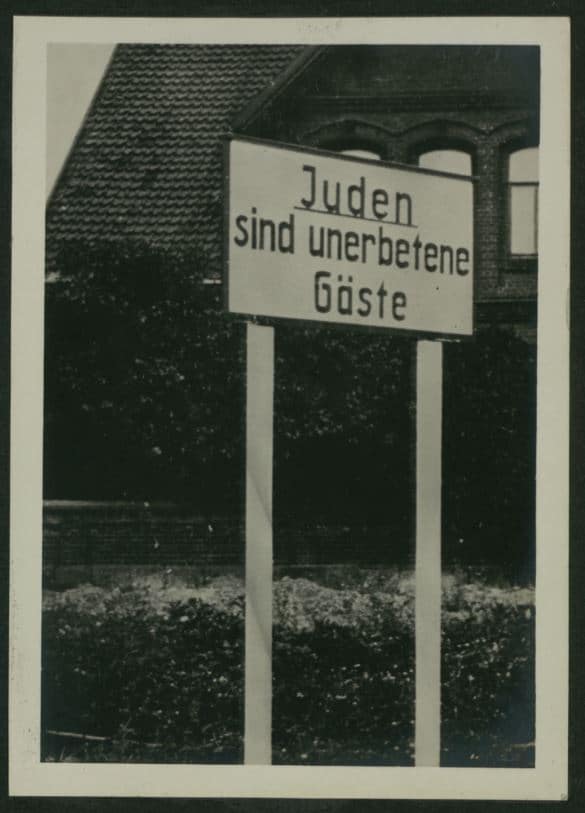
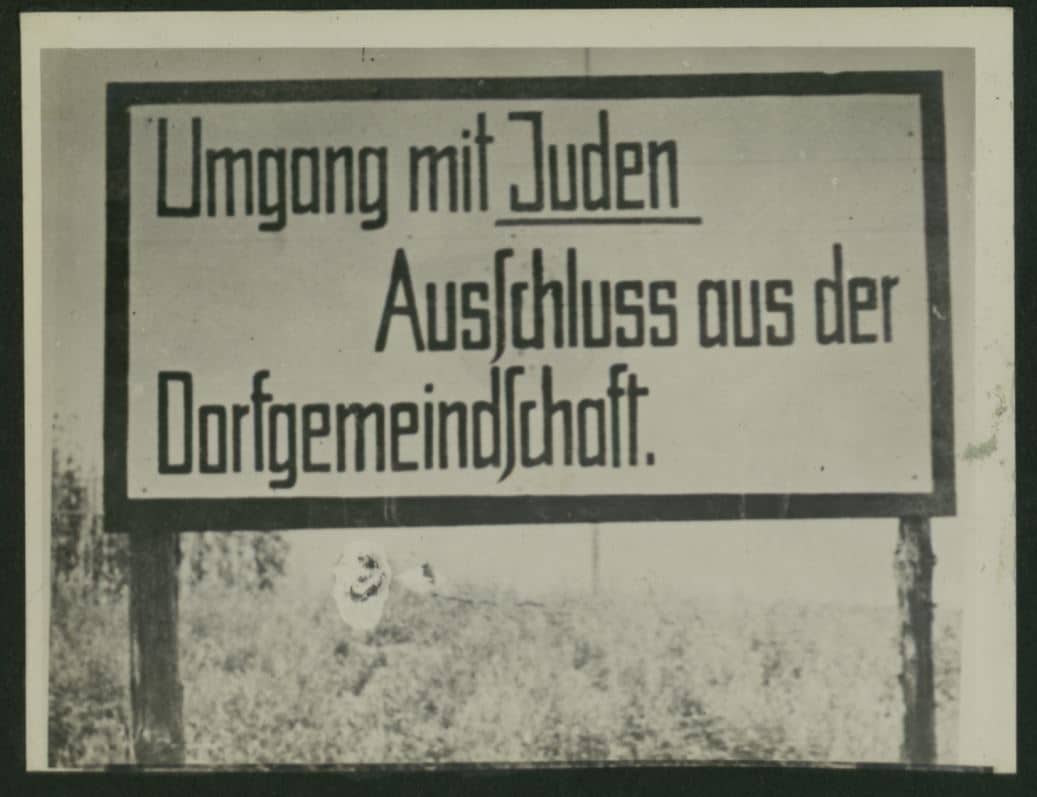
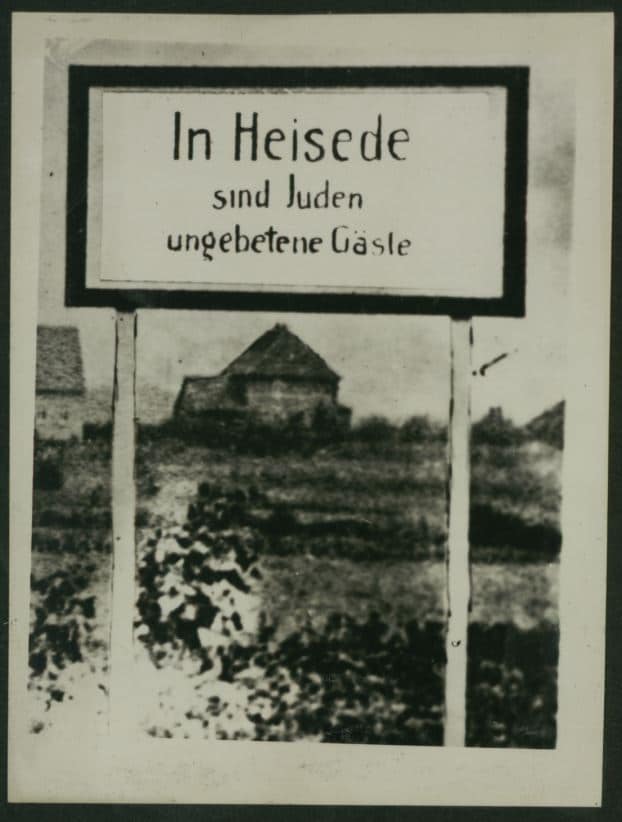
In January of 1936, a photo album arrived at the National and University Library. The album was sent to Jerusalem by the head office of the Jewish News Agency in Amsterdam. It was not a large album and contained just twenty-two photographs. Each image in the album documented a sign that was hung in condemnation of the Jews, a public declaration of anti-Semitism and hatred of Jews in Germany, providing a simple snapshot of life under Nazi rule as documented in the autumn of 1935.


A map of Nazi Germany. The red line indicated the route taken by the Dutch photographer on his motorcycle.

The photographer’s name did not appear in the album and seemingly was not preserved through the upheavals of history.  The photographer, a Dutchman who rode his motorcycle from the county of Bentheim on the Dutch-German border, through Hamburg, all the way to Berlin, covering a distance of 500 kilometers, was sent by two Jewish journalists from Holland named Hans Reichmann and Alfred Wiener.

The pair established the Jewish Central Information Office in Amsterdam in 1929 with one goal in mind: to document the true nature of Nazi Germany as it was revealed and to make evident the Nazi treatment of the Jews to the world. The staff of the Jewish Central Information Office hoped that disseminating the pictures would rally public opinion and remove any doubts regarding the nature of the racist regime that had successfully come to power under the leadership of Adolf Hitler.

“Jews are unwanted guests”

But it seems that they failed at their mission. The photos were indeed publicized throughout the world with a copy of the album successfully reaching even the far off Land of Israel, but the hoped-for resonance was not achieved and the world paid no mind. It was surely a naïve hope on the part of Reichmann and Wiener that these images would have their intended effect.

Join our group to learn more about Jewish life in Europe:


“Contact with Jews = exclusion from the village community”

In 1939 Reichmann and Wiener were forced to halt their activities, and consequently, they emigrated from Amsterdam to London. It was there that Alfred Wiener donated his collections to an institution that later became the Wiener Library, now one of the most important documentation centers in the world for the study of anti-Semitism and the Holocaust. Another copy of the album now resides at the Wiener Library, testifying to the courageous attempt of a group of brave German Jews to alert the world and arouse public opinion against the crimes of the Nazis three years before the outbreak of the war.

“The road to Palestine does not cross through here!”

Homegrown German Anti-Semitism

When delving deeper into the background of the seemingly simple photographs showing roadside signs and other posters from the entrances to small and large localities alike, we learned that the photographer did not document official Nazi policy. What becomes apparent from the photographs is that the residents of Germany themselves prepared the signs and placed them in their own environments as a way of expressing their personal sentiments towards the Jewish minority.

“Jews: Immigrate to your land – in our land, we already know who you are.”

“We do not want to see Jews, Jews are the source of our trouble, they feed off of our bodies.”

“Jews are not wanted here.”

“The local community wants no contact with Jews.”

Recommendations for where the Jews should go instead were also posted:

“The road to Palestine does not pass through here.”

“Jews: Immigrate to your land – in our land, we already know you.”


Sign at the entrance of a town to discourage Jews from entering.


Sign at the entrance of a town to discourage Jews from entering.

Not one such sign was required by law. All of them were posted as an expression of authentic local and national sentiment – stated clearly in block letters without any reservation or apology. These signs which espoused a genuine hatred of Jews, the perspective that the Jew is a foreigner from another land, and complete rejection of the Jews, gave a clear indication as to the dark future ahead.

If you liked this article, try these:

Felix Nussbaum: Painting a Self Portrait of Death in the Holocaust

When Buchenwald Was Liberated: A First Glimpse of the Holocaust

How Anti-Semitism Robbed the Jewish Miss Europe of Her Crown


Caught in the Rain? This Yiddish Umbrella Service Is Precisely What You Need!

Meet the first Jewish start-up for umbrella rentals!

1

As a Jewish history buff, I spend a lot of time on JPress (the Historical Jewish Press website), and every day I stumble upon another pearl.

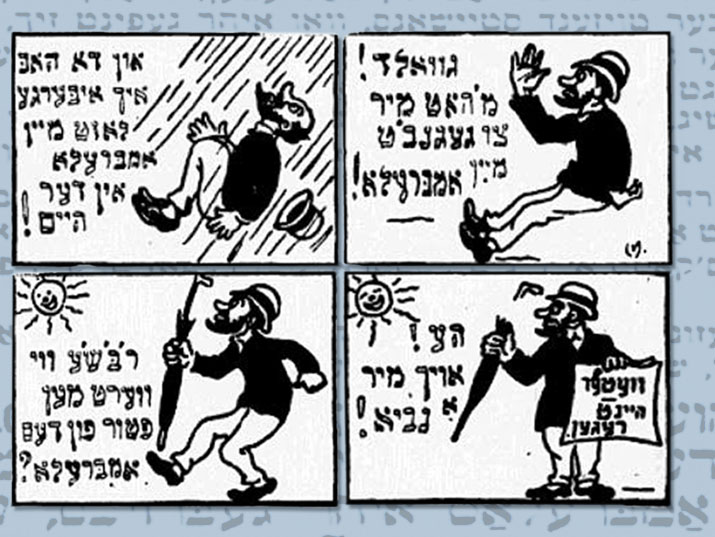
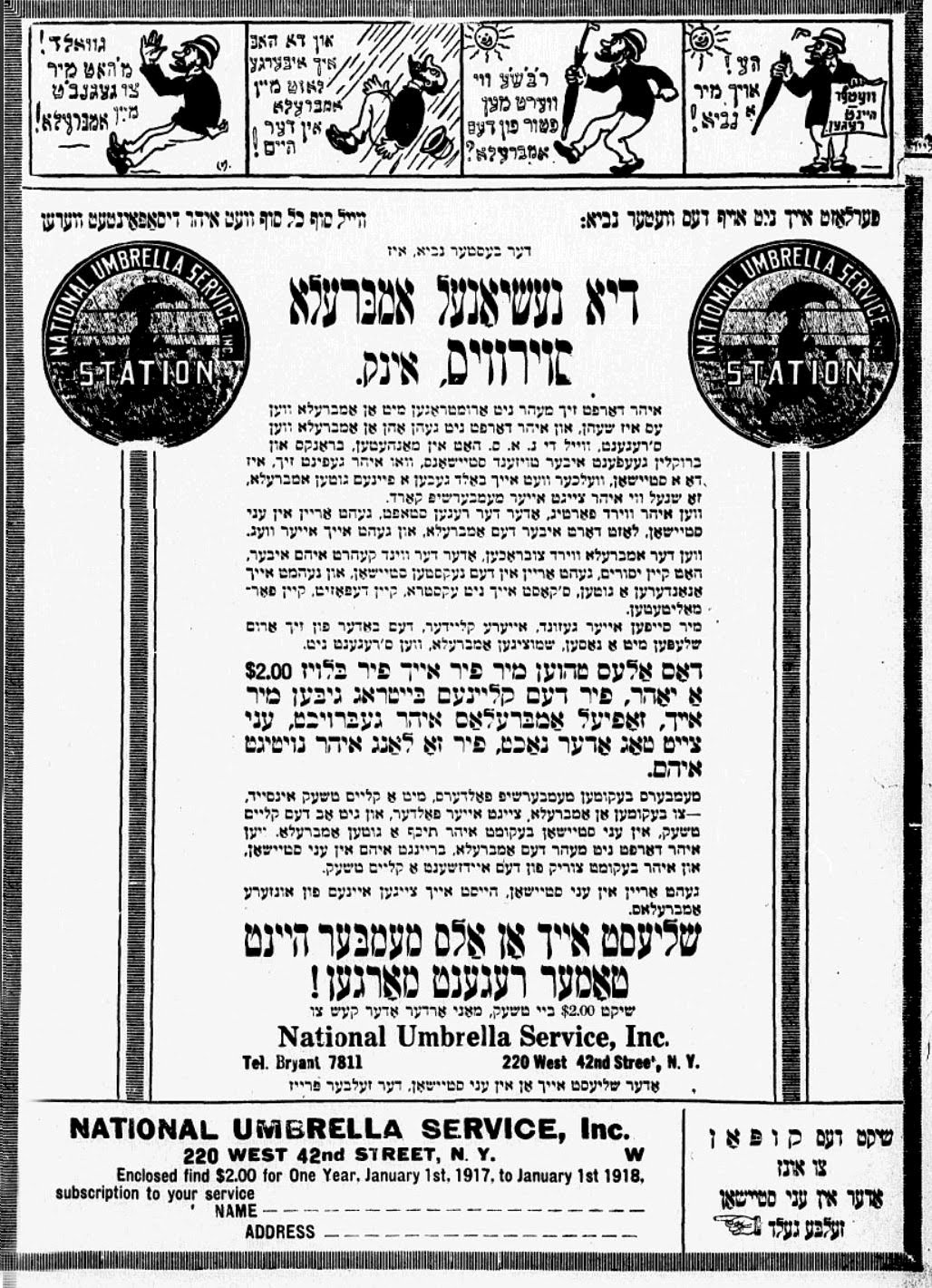
A few days ago, I found in the December 31, 1916 issue of the New York Yiddish newspaper Die Wahrheit, what seemed like one of the craziest start-ups I had ever come across in my life: the National Umbrella Service Inc. Not only did the service look innovative, the advertisement was also pretty creative.


1


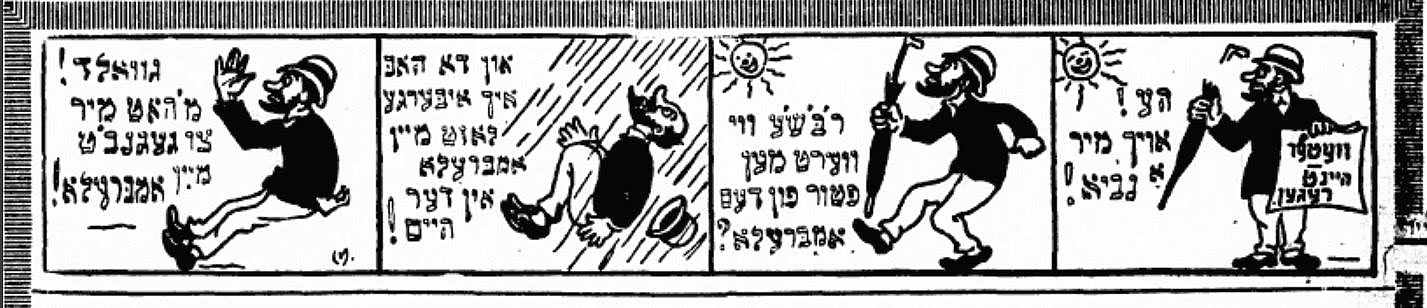
Let’s begin with the comic strip at the top. A Jew leaves his house in the morning (you can see that he’s Jewish, right?) holding a weather report that says “Rain Today,” while outside the sun is shining! “Hah. Another prophet!” says the Jews to himself holding up his umbrella. In the next frame, the smiling sun beats down on the fellow, who says: “Good God! How can I get rid of this umbrella!”


1

In the next picture, it’s pouring outside, and the forlorn Jew says, “I left my umbrella at home!” And in the last illustration, he cries, “Gevalt! Someone stole my umbrella!”

So, how did this start-up work? For those Yiddish-challenged readers among us, the ad says that: across Manhattan, the Bronx and Brooklyn over 1000 umbrella rental stations have been opened. All one had to do was pay the two dollar per year subscription fee and you could borrow, return, fix or exchange a broken umbrella on the spot at no extra cost!

What a concept! This surely promised an end to shmutzicke umbrellas! (The proper Yiddish word for umbrella, by the way is shirem.) While we’re at it, here’s a funny little Yiddish curse: Zol er aropshlingen a shirem un s’zol zikh im efenen in boykh! – “May he swallow an umbrella and have it open up in his belly!”

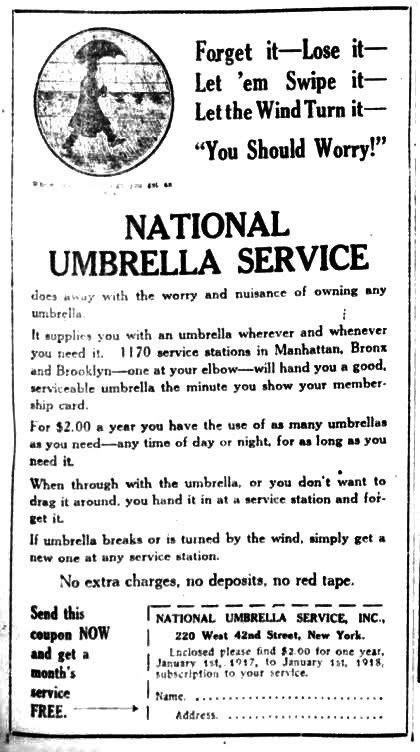
So what became of this revolutionary idea? To find out, I consulted the American historical newspaper website Chronicling America, where I found more ads for the National Umbrella Service, such as this rather dry one (for such a wet business, and without even a bit of Jewish humor) in the New York Tribune from December 14, 1916.


1

The fact that the ads ran for just two weeks—from mid-December until the beginning of January—is more than enough proof that the business never really took off. Indeed, the “Business Troubles” section of the June 14, 1917 issue of The Sun, includes an item about the National Umbrella Service filing for bankruptcy.

But why did this umbrella business collapse? Did others succeed where it failed? If a bike-sharing service can make it, why not an umbrella-sharing one? It seems that the people of China don’t read the Yiddish press, and perhaps that’s why a recent venture of theirs failed in similar fashion: In 2017, the Chinese entrepreneur Zhou Shu Ping from the city of Shenzhen launched an umbrella sharing service in Shenzhen and 11 other cities, but within a few months almost all of the project’s 300,000 umbrellas had been stolen.

1


Another, more modest, umbrella-sharing service called UMBRACITY, is operating for the time being in Vancouver, Canada, with dozens of smart umbrella rental stations scattered in stores across the city. How does it work? There’s an app: push a button on your smartphone and the umbrella is yours.

1


There are more—in the city of Aarhus in Denmark, the DripDrop service has over 25 umbrella stations throughout the city. The rather unimaginative slogan is: “Happiness is having an umbrella when it rains”


1

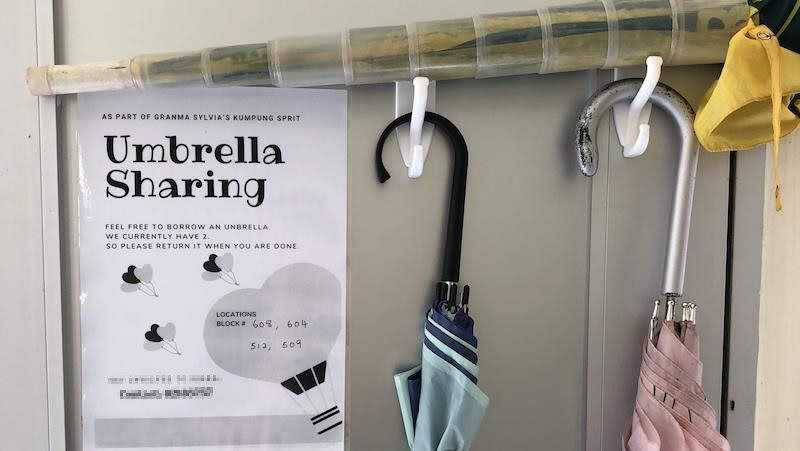
And there are some somewhat less sophisticated services like this one which opened up a few days ago in the Pasir Ris neighborhood in Singapore, dedicated to the memory of Grandma Sylvia.

1

In any case, whether you’re renting or you’ve decided to buy, we urge you to always have an umbrella at hand during this rainy season. As they say: Men antloyft fun regn, bagegnt men hogl! – “Run away from rain and you get hail!”


If you liked this article, try these:

Who Spilled Honey on the 18th Century Manuscript?

Spotted Off the Shores of the Holy Land: The Little Mermaid

The Package is Secure: How Jewish Women Were Smuggled to Safety in 19th Century Italy

`;