Coffee Houses Open on Shabbat… With Rabbinic Approval

Records from 18th century Prague show that the opening of Jewish coffee houses on Shabbat enjoyed the approval of the city’s rabbinic leadership.

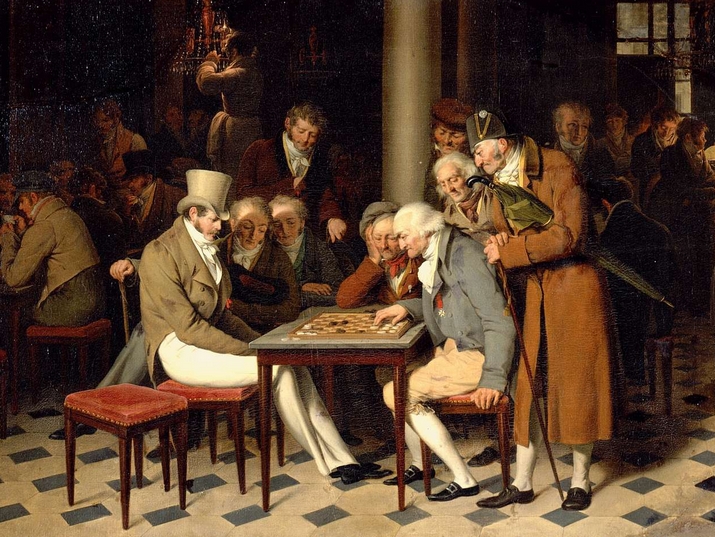
A Game of Draughts at Cafe Lamblin by Louis Leopold Boilly

A Game of Draughts at Cafe Lamblin by Louis Leopold Boilly

In the middle of the eighteenth century, religious life in the Jewish community of Prague was at its high point, with nine well-known synagogues and dozens of study houses. But at the same time that the learned men of Prague were producing vast Torah scholarship and the yeshivas were bustling with students, another institution was gaining popularity – the coffee house. Coffee houses became popular soon after coffee’s arrival in Western Europe, and often offered more than just a drink; they were a place to spend leisure time playing games and discussing current events with friends and strangers. Rabbinic sermons and writings from this period warn of the spiritual threat posed by the coffee house.  These establishments’ diverse environment and leisure culture competed with the traditional Jewish lifestyle of worship and study.

In spite of this potential culture clash, the records from that time period in the Pinkas Beit Din – the minute book of the rabbinic court of Prague – show that the opening of Jewish coffee houses on weekdays and, shockingly to modern ears, even on Shabbat, enjoyed the approval of the city’s rabbinic leadership, along with careful, detailed rabbinic-halachic regulation.

The Pinkas (minute book) of the Rabbinic Court of the Holy Congregation of Prague, currently preserved in the Jewish Museum of Prague, is a hand written book which, records the decisions of the rabbinic court, one of the most important governing bodies of the Prague Jewish community. This pinkas, written in a mix of Hebrew and Yiddish, begins in 1755 and survived the Holocaust even as the community it records was wiped out, provides important testimony to Jewish daily life in Europe.

A pinkas from 18th century Prague, the National Library collections
A pinkas from Halberstadt, the National Library collections. Click to enlarge.

In the Prague Pinkas Beit Din, the numbers alone – seven discussions about coffee houses within fifteen years – tell us how pressing and how complex this issue was. The entries show a swift progression, from disapproval and severe limitations to support with minimal caveats. Evidently community members had embraced coffee-house culture and were not about to give it up. The pinkas entries also show the style of religious leadership adopted by the rabbinic courts of Prague in this case: instead of opposing a cultural trend that threatened traditional life, the rabbis accepted the new trend, which gave them the opportunity to regulate and contain its impact, and to integrate the new institution into the traditional mode of Jewish life.

One of the first discussions in the pinkas, from around 1757, begins by taking a hard line – Ideally the coffee houses in the Jewish ghetto should be closed, and people should instead dedicate their time to Torah study. Since that is impossible, they should open only for an hour in the morning, after morning services at synagogue, and then for an hour following afternoon services. Women should never enter coffee houses. With regard to Shabbat, “no man should dare to go to the coffee house and drink coffee there on the holy Sabbath. This is punishable with a large fine!

This discussion is followed by another paragraph, presumably added days or weeks later:

However, due to the travails of war (presumably the siege of Prague in the spring of 1757, part of the Seven Years War) and other concerns, many have protested that we cannot be so stringent on this matter… the way to distance from sin will be that on the holy Sabbath, no one should go to the coffee houses to drink coffee, but anyone who wishes to drink should bring it to his home. And on weekdays, any time they are praying in the Old New Synagogue (Altneuschul), no man should dare go drink in the coffee house.

The added paragraph shifts the balance significantly, permitting Jews to frequent coffee houses at all times except during prayers; allowances are made for procuring coffee on Shabbat as well. Apparently the Jewish coffee sellers had an arrangement in which customers paid before or after Shabbat, and they could prepare the coffee without violating Shabbat laws about cooking, perhaps with the help of non-Jewish workers. The main concern is the propriety of spending time in the coffee house on Shabbat, so getting the coffee as takeout is a suitable compromise, but not one that lasted long.

The famous bridges over the River Vltava, Prague.

The next two entries on this topic in the pinkas, dated 1758 and 1761, are each signed by eight Jewish coffee house owners. One declares that coffee will be sold only until noon on Shabbat, and one states that coffee will be sold without milk on Shabbat, presumably in order to avoid serving dairy to customers who had just eaten a meat meal.

A fourth entry, dated 1764, declares:

From this day onwards, on Shabbat and holidays, women are not to enter coffee houses to drink coffee at all. And even on weekdays, from 6 PM onwards, no woman or women should be found in the coffee house…

These entries assume that, despite earlier restrictions, women are indeed entering coffee houses. Moreover, coffee houses are not only providing coffee for takeout on Shabbat, customers are sitting and drinking coffee there, and the rabbinic court is only trying to limit that clientele to men.

A fifth entry, dates 1774, states:

The owners of the coffee houses stood before the rabbi and the rabbinic court, who warned them that they should be careful to avoid selling coffee on Shabbat and holidays to non-Jews, as the prohibition of commerce on the Sabbath applies. They are permitted to sell only to Jews, for the sake of Oneg Shabbat, delighting in the Sabbath day, since not everyone is able to prepare coffee for himself on Shabbat at home.
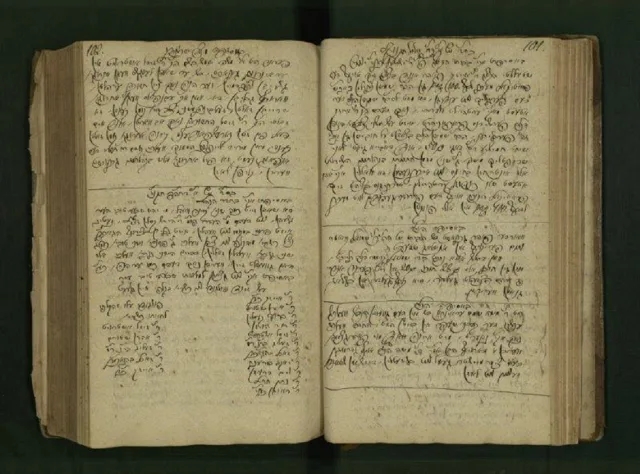
A pinkas from 18th century Prague, the National Library collections. Click to enlarge.
A pinkas from Zülz, the National Library collections. Click to enlarge.

To the rabbis of eighteenth century Prague, the coffee house’s ambiance of levity and cultural exchange competed with the traditional understanding of the proper Shabbat atmosphere. The rabbinic court therefore made efforts to restrict Jewish coffee houses’ activity on Shabbat, with limited success. But in their final entry on this topic, the Prague Beit Din provided the coffee houses with a religious stamp of approval, pointing out that Jews attending coffee houses on Shabbat was in fact a fulfillment of the religious injunction to delight in the Sabbath day. The rising cultural significance of coffee in European regions, since its import a few decades ago, is now reflected in the the pinkas; the new product is incorporated into halachic language, labeled, for the first time, as “Oneg Shabbat” – a positive value which should be carefully considered.  The coffee house and the synagogue need not always be rivals: within certain parameters, both could be part of a meaningful and enjoyable Sabbath day in Prague.

The National Library of Israel, together with the Central Archives for the History of the Jewish People in Jerusalem, holds the largest collection of pinkasim in the world. Through international academic co-operation, the Pinkasim Collection aims at locating, cataloguing, and digitizing all surviving record books, making them freely available. At the first stage of the project, the focus is on pinkasei kahal, the pinkasim of the central governing body of Jewish communities. On June 20th, the National Library will host an event marking the launch of the Pinkasim Collection, which will feature experts from around the world, and will include a lecture by Maoz Kahana about coffee houses in Prague.

You can read more on this subject in the article by Dr. Maoz Kahana, ‘The Shabbes Coffeehouse – on the emergence of the Jewish Coffeehouse in eighteenth-century Prague’, Zion 78,1 (2013), pp. 5-50 , which you can find here.


If you liked this article, try these:

The Eastern European Pinkas Kahal: Image and Reality

Roll Out the Red Carpet: When the Royals Paid a Visit to the Jews of Amsterdam

The Disappearing Headstones from the Jewish Cemetery of Ferrara


The Italian manuscript A General Response to the Desecration of Sanctity in the Hebrew Books (henceforth Response), now kept by the National Library of Israel, provides an important example of Catholic book censorship in the modern age. Written by an anonymous Jewish author in Ferrara during the seventeenth century, this document focuses on religious disputes concerning the accusation of blasphemy made by the censors of the Roman Inquisition against rabbinical literature.

The accusations made against Hebrew texts refer especially to Talmudic works whose reading could lead to negative interpretations of Christianity.

In order to effectively forbid these texts, Catholic censors needed to control any source of Jewish culture which could be spread easily among Christians. The printing of books and documents in the modern age revealed itself to be an excellent means of canonization. The main problem concerning Hebrew texts in the modern era was related to their availability as they were often limited to Jewish communities. The view held by the Catholic Church regarding Jews and Judaism was strongly conditioned by the polemic work “Pugio Fidei,” or, in English, “Dagger of Faith,” written by the Dominican friar Ramon Martí. It’s possible to identify two interpretative lines about Judaism in this document: the first interpretation is founded on the idea that holy Jewish books are full of useful evidence of religious truths, thanks to the many resemblances with Christianity, while the second traces a negative connotation of Hebrew texts, with emphasis on the Talmud. The negative inclination in the Pugio reclaims the traditional thesis on the vanity of Talmudic literature, that is seen as a blasphemous attack on Christians. The success of the negative narrative posed about Judaism led to the censorship of Jewish texts.

Since the above-mentioned manuscript is a “general response” to the Roman Inquisition, let us now examine its structure in order to better understand its content.

1
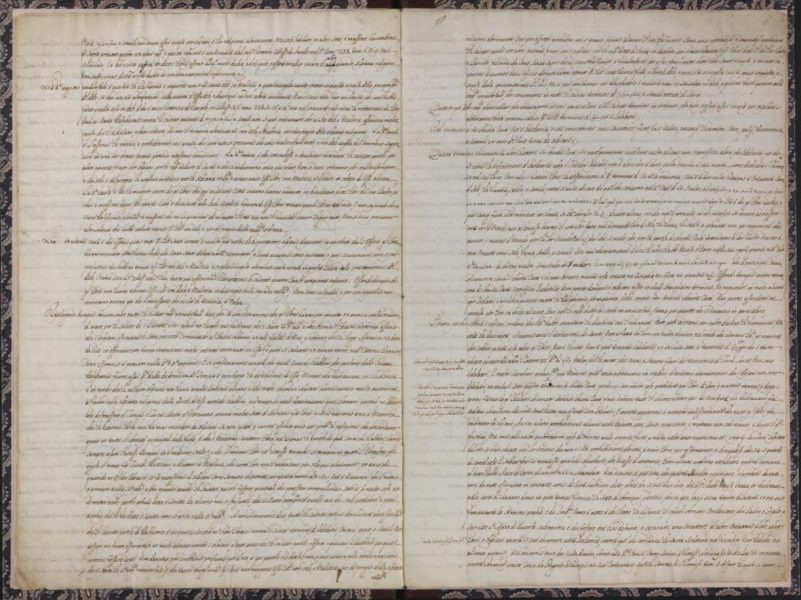
A page from within the manuscript, “General Response to the Desecration of Sanctity in the Hebrew Books.” In the margins, there are long quotes and citations in Hebrew. From the National Library of Israel collections.

General Analysis of the General Response: A Philosophical and Philological Profile

One interesting aspect worthy of consideration in the manuscript is the use of philosophical reasoning to argue the theory that Hebrew texts do not contain negative remarks about Christianity. In order to support this thesis, the anonymous author of the code presents eight “universal reasons” that would demonstrate the unfoundedness of the accusations against rabbinic literature.

The first universal reason explained by the author focuses on the importance of prayer in Jewish tradition, whose history is proved through important textual references from Flavius Josephus or from Philo of Alexandria, who describes the devotion of Jewish prayer in his “De Legazione ad Caium Imperatorem”. These references serve as fundamental proof of the benevolence Jews had towards other nations and their leaders, even during and after the destruction of Jerusalem, as Josephus’ Bellum Iudaicum shows. Words like “idolaters” and “heretics” begin to appear in the first two pages of the manuscript to exhort the readers to understand that such terms refer to Babylonians and Romans, who are seen as idolatrous pagans. Hence, definitions such these can’t and mustn’t be seen as reffering to Christians, according to the author.

Join our group to learn more about Jewish life in Europe:

The second universal reason is founded on a syllogism. It states that all people who follow the seven laws of Noah will partially enjoy Heaven. As Christians follow the seven laws of Noah, they, according to Jewish beliefs, will partially enjoy Heaven. The consequence of this reasoning confirms again that Christians cannot be percieved as idolaters or heretics by Jews, also because they share a common concept of blasphemy. In fact, in both Christian and Jewish holy texts it is forbidden to be involved in actions that offend God, including idolatry, homicide, adultery or theft.

A General Response to the Desecration of Sanctity in the Hebrew Books
A page from within the manuscript, General Response to the Desecration of Sanctity in the Hebrew Books, from the National Library of Israel collections.

It’s also clear that, although Christians share some religious beliefs with Jews, they don’t necessarily observe all the same rules. For example, the precepts regarding the eating of meat from a slaughtered animal aren’t part of Christian orthodoxy, but yet Christians still are till given the opportunity to achieve  “eternal happiness”. This is possible because they are seen as “good and pious.” The author focuses his attention on the meaning of the expression “good and pious”, and dedicated his third  in argument to this point. Since Christians believe that the seven laws of Noah came from God, the requisite of being “good and pious” is fulfilled. In addition, it is not necessary to follow all the seven laws given to Noah as long as one of them is observed with “good intention.” Moreover, the author explains a passage from the ninth psalm of David, recalling that these verses describe the fate of those who are not “good and pious,” pointing out that the expression “all people who leave God”  (Obliviscuntur literally means “they forget” and can be interpreted as “ they leave” in a figurative sense) is meant for those who are neither good nor pious, seeing as they deny the glory of God.

For what concerns the goodness of Christians, in the manuscript it is written that the Ten Commandments they follow are thought to have come from God and this proves a convergence between Jewish and Christian beliefs: the Ten Commandments given to Moses include many precepts shared with Judaism and given the fact that Christians follow many precepts of Mosaic Law with good intentions , consequently they can’t be described as heretics or idolaters.

A page from within the manuscript, General Response to the Desecration of Sanctity in the Hebrew Books, from the National Library of Israel collections.

In the Response, the theme of religious observance is often reiterated through references to Don Isaac Abarbanel, a philosopher, statesman and biblical commentator, King David (in his fourteenth psalm), or the prophet Isaiah, whose verses are mentioned to affirm the need to follow even just one precept to avoid damnation. Proceeding in the analysis of the manuscript, the author explains that the rabbinic doctrine on intention in religious observance is surely influenced by the moral philosophy of Aristotle. His theory of purpose is founded on the notion of prudence, as explained in the sixth book of Nicomachean Ethics, where it is written that each moral virtue depends on prudence, defined as the “common form of virtues.”

The anonymous author presents a fourth universal reason, maintaining that there are three aspects to be considered for a correct evaluation of rabbinical texts including when these books were written, who wrote them, and for whom. Following this argument, words like “idolaters” or “heretics” are to be intended for those people living when “ancient rabbis” instituted their doctrines, and without any doubt, in that historical period, Christianity wasn’t yet established. In particular, Babylonian and Roman ceremonies are seen by the ancient Jewish sages as examples of idolatry and blasphemy. In addition, a certain passage from Saint Augustine (De Civitate Dei, 23) is mentioned, which describes both the Babylonian captivity of the Jews and the destruction of the 2nd temple of Jerusalem under the Roman Empire. The first event happened before the emergence of Christianity, while the second was the result of an expansionist policy led by the Roman Empire when Christians communities were persecuted as well.

A page from within the manuscript, "General Response to the Desecration of Sanctity in the Hebrew Books," from the National Library of Israel collections.
A page from within the manuscript, General Response to the Desecration of Sanctity in the Hebrew Books, from the National Library of Israel collections.

The author also states that most of the content reffering to rabbinical texts is unclear, containing many ambiguous terms and figures that are easily misunderstandable, and for this reason they are percieved as offensive by Christians, even if they not addressed to them. Additionally, the author describes Christianity as a religion which is very close to Judaism, since it shares many common beliefs. He even argues that Judaim holds a benevolent attitude towards Christianity. The word “idolaters” therefore appears to be associated with “gentiles.” The term “goyim” refers to a non-Jewish nation and in the manuscript, this definition is used in reference to the Babylonians people. The author’s fifth argument make the case that none of these words refer to Christians, since Christians were called “Nazarenes”, and this epithet is significant since it distinguishes “orthodox” Christians from Arian Christians, who are mentioned as heretics in the manuscript/

This point is strictly related to the sixth argument brought forth by the author, in which he writes that the above-mentioned terms are so generic that they can easily refer to other nations or groups of non-Christian people:  these words even can be associated to communities inside Judaism.

Given the fact that the above-mentioned epithets are ambiguous, it cannot be concluded that they are addressed to someone in particular, as illustrated by the seventh argument; furthermore, blasphemy is assumed to be founded on a malicious intent, therefore something that is never verified cannot be presumed without evidence, in accordance with the eighth argument.

A page from within the manuscript, "General Response to the Desecration of Sanctity in the Hebrew Books," from the National Library of Israel collections.
A page from within the manuscript, General Response to the Desecration of Sanctity in the Hebrew Books, from the National Library of Israel collections.

After the presentation of all the eight “universal reasons,”  the last page of the manuscript seems incomplete;  nevertheless, it makes sense to affirm that the anonymous author of this code managed to discuss all the eight points of his reasoning with historical, theological, philological and philosophical references that together contribute to a better perspective on the relationship between Jewish and Christian traditions.


`;