Who Stood With the Orphans When the Nazis Came?

Meet Doctor Henryk Goldszmit who refused to leave the Jewish orphans to face the Nazis alone.

Janusz Korczak, in the yard of the orphanage, the Ghetto Fighters' House Archives

Warsaw, Poland, the interwar period.

Doctor Henryk Goldszmit makes his way to the Jewish orphanage he founded on Krochmalna Street. As he passes through the gates, he is greeted with the joyous cheers of excited children, happy to see the kind doctor return once again.

In the Polish landscape of the early 1900s, this orphanage was considered atypical compared to other orphanages of the time. Dr. Goldszmit, an advocate for children’s rights, created a system wherein the orphanage was governed by a children’s parliament and courthouse. The parliament set the rules that everyone, including the staff, had to follow. Every child was also fully entitled to summon to court any resident of the orphanage who had injured or harmed them in any way – including the warden and the doctor himself.

Beyond having administrative and judicial power equal to their caretakers, the children in this orphanage received special attention from the institution. This included a higher level of medical treatment, proper nutrition, and most importantly, they were treated warmly and humanely, their dignity and rights were upheld and they were treated with remarkable understanding and patience for their emotions.

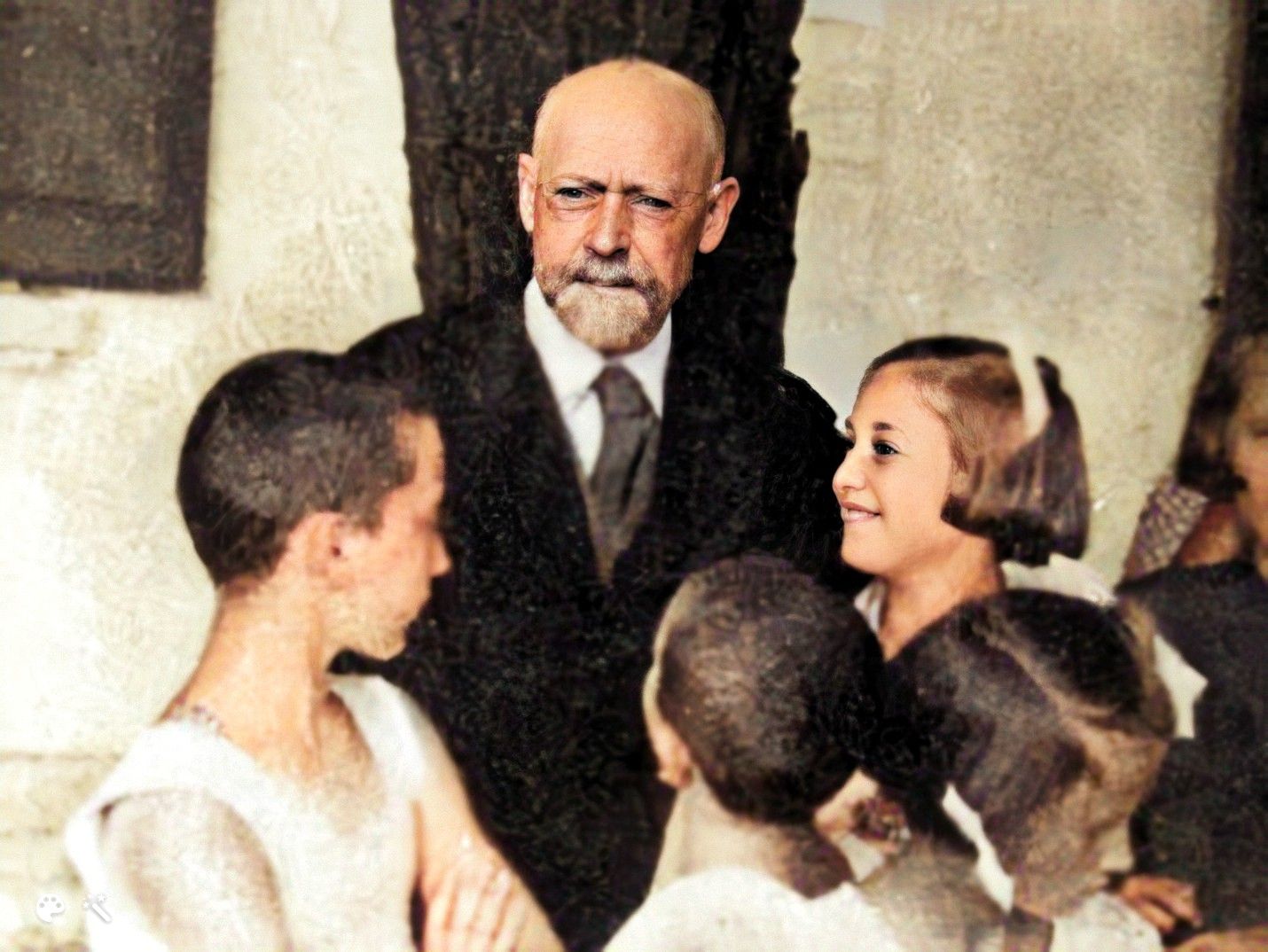
Janusz Korczak at the orphanage. Photograph by A.Y. Poznansky, 1930. From the From the Abraham Schwadron Portrait Collection at the NLI.

Doctor Henryk Goldszmit was not just a successful and well-regarded doctor; he was a war veteran, an accomplished philosopher, storyteller, author, lecturer, host of a popular radio show, and the founder and editor of a popular newspaper written entirely by children.  He was also a well-respected researcher and educator. Despite his many accomplishments and achievements, few know his true name. Most people know him only by his pen name: Janusz Korczak.

In 1937, as the flames of anti-Semitism spread across Europe, Korczak was forced to give up his many high level positions and end his involvement in the Polish orphanage that he ran alongside the Jewish orphanage. He penned a letter expressing his desire to leave Poland and move to the Land of Israel: “I have made a decision: I would like to live out my final years in the Land of Israel, for the time being in Jerusalem. There I will learn the Hebrew language in order to move to a kibbutz after a year.”

His vision for the future never came to fruition despite having visited Israel several times. Korczak remained forever faithful to the children of the orphanage and thus, remained in Poland.

Zrubavel Gilad, an Israeli author and poet, visited the orphanage in Poland in 1938 where he had the chance to experience the unique atmosphere the doctor had created for the young orphans. “When we entered the home we were greeted by loud cheers from the joyful children- the standard exuberant welcome for the beloved doctor,” Gilad recounted.

In 1940, the Jewish orphanage was forced to move from its comfortable and familiar home on Krochmalna Street to the Warsaw Ghetto. The orphanage became crowded and cramped as the number of orphans in the small residence nearly doubled. There, in the shadow of poverty, hunger, desolation, and the spreading plague of typhoid, Korczak fought daily to ensure his children at the orphanage had enough food to live a decent life in as much as the circumstances allowed.

Inside the walls of the ghetto, Korczak continued to run the orphanage with his unique philosophy, producing cultural events and special activities such as concerts and plays to keep the children busy, entertained and happy.
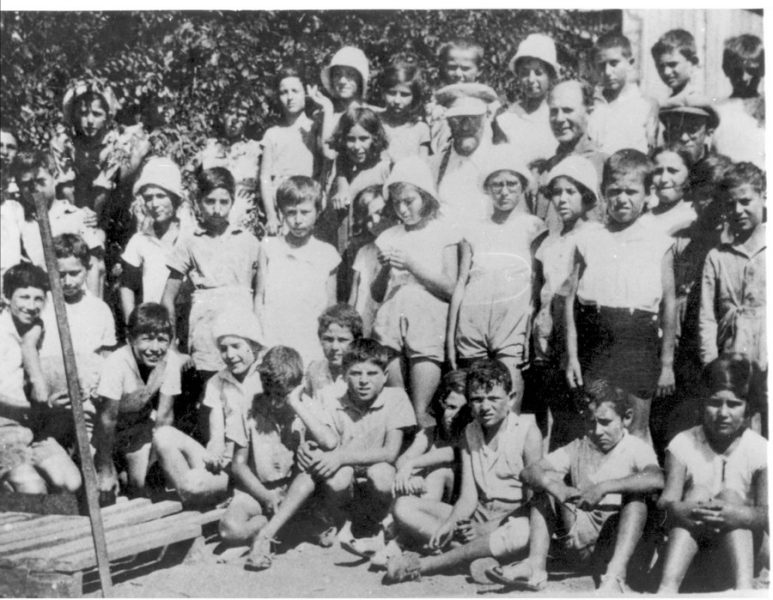
Janusz Korczak with the children of the orphanage.

On the 5th of August, 1942, Korczak was forced, along with 192 children and the 10 members of his staff, to leave the safety of the orphanage and march to the main square of the Warsaw Ghetto where they were to board the train to the Treblinka death-camp.

The well-renowned and beloved doctor was offered an escape, a chance to save himself from the inevitable death that faced the passengers of the train. Instead, Korczak marched, head held high, alongside the orphans, as they drew closer to the final ride of their lives.

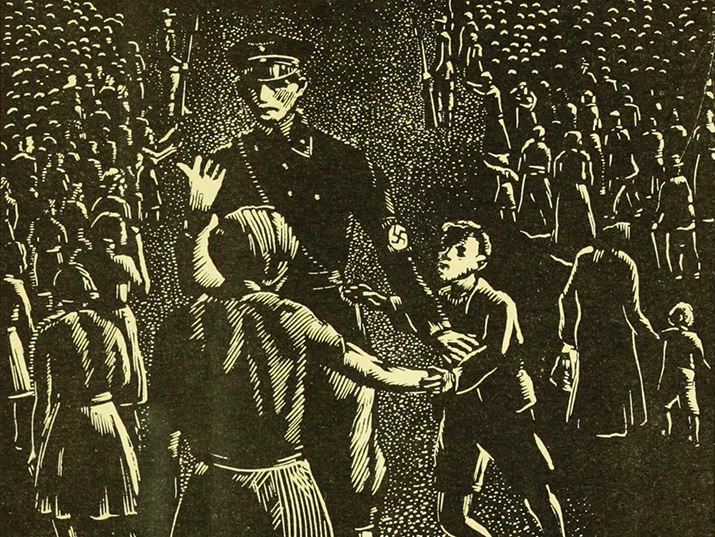
With a child on each side, and a child in each arm, Korczak marched towards the train, refusing to leave behind the Jewish orphans. They marched together, the children and their greatest friend and advocate.

The witnesses of this scene who survived to share the experience expressed a feeling of unbearable sadness, despair and complete helplessness at the sight of the innocent children and their teacher as they were led to their deaths. They described the doctor, leading the crowd, proud and dignified. One of humanity’s gentlest and most noble figures was ultimately murdered, during that dark and cruel chapter of human history.

Related articles:

“Letter Returned to Sender: The Council of Jews no Longer Exists”

When the Nazis Desecrated the Jewish Cemetery of Salonika

The Artist Who Forewarned the Dangers of the Nazis


The Haggadah That Brought the Nazis to the Seder

A glimpse into a Haggadah written for the residents of the displaced persons camp in Munich, illustrated by a Holocaust survivor.

For many of the residents of the displaced persons camp in Munich in April, 1946, the upcoming Passover Seder symbolized more than the Jewish people’s historical redemption; it was the reality unfolding before their eyes. Many of the survivors clustered together in the displaced persons camp had hoped that they would celebrate Passover of 1947 far from the land where their loved ones had been slaughtered, far from the land in which the Nazis and their collaborators aimed to destroy them and the entire Jewish nation. Those in the know spoke about that Passover night as the “Seder of the exodus from Europe”.

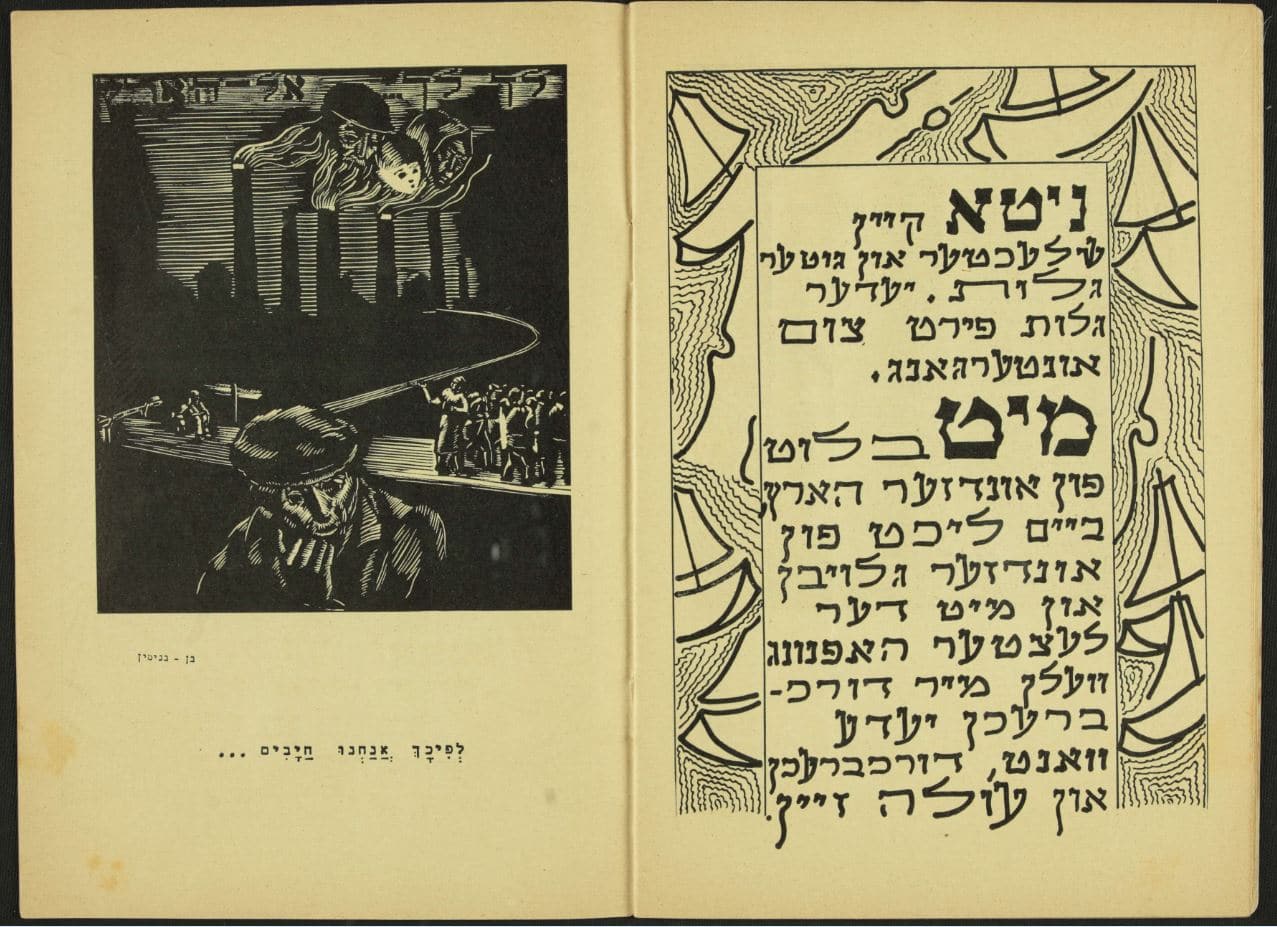
Yosef Dov Sheinson, a resident of the camp, wanted to express this sentiment in a Haggadah which he wrote for the Seder in the displaced persons camp. The excerpts in Hebrew and Yiddish which Sheinson added to the traditional haggadah are accompanied by woodcuts by the Jewish-Hungarian artist Zvi Miklos Adler, who signed his name in the Haggadah as “Ben Binyamin”.

Depicting the horrors of the Holocaust which he himself experienced during the war years, Adler’s harsh drawings complement the text of the Haggadah. In an illustration corresponding with the well-known sentence “for not only one has risen against us to destroy us” we see a soldier shooting several wretched looking prisoners, while another soldier leads a group of stooped prisoners toward an unknown destination. The picture gradually fades away as the prisoners move away from the center of the event.

“For not only one has risen against us to destroy us”

The intertwining of traditional text and modern pictures illustrates the way the creators of the Haggadah grasped the historical moment in which they lived: in each and every generation a person must see himself as if he left Egypt, but it is not in every generation that a person undergoes horrors which darken his world and dwarf the suffering experienced by his ancestors.

“For Pharaoh only made decrees against the males, and Laban wished to uproot everything”

The need to talk about and deal with the terrible topic is tangibly and explicitly expressed in the Haggadah in an illustration which is hard to look at, and under which is written, “Therefore we are obligated…”

While this excerpt in the Haggadah is usually dedicated towards praise and thanksgiving to God for redeeming us from Egypt, the expression on the face of the survivor at the bottom of the picture shows quite the opposite.

“Therefore we are obligated…”


“And they oppressed us and imposed hard labor upon us”

Passover Seder in the U.S. Army

A copy of this haggadah reached Rabbi Avraham Klausner, an American army chaplain who was in the midst of preparing for a Seder of the U.S. Army forces stationed in Munich. He decided to conduct the Seder according to this haggadah, making a single change – he added an introduction addressed to soldiers in General Eisenhower’s army (whom Klausner compared in his introduction to a modern-day Moses).

Rabbi Klausner’s introduction is in the same vein as Sheinson and Adler’s work, equating Hitler with Pharaoh and the suffering the Jews endured in Egypt with what the Jews went through in the concentration and death camps.

“We were slaves to Pharaoh in Egypt”

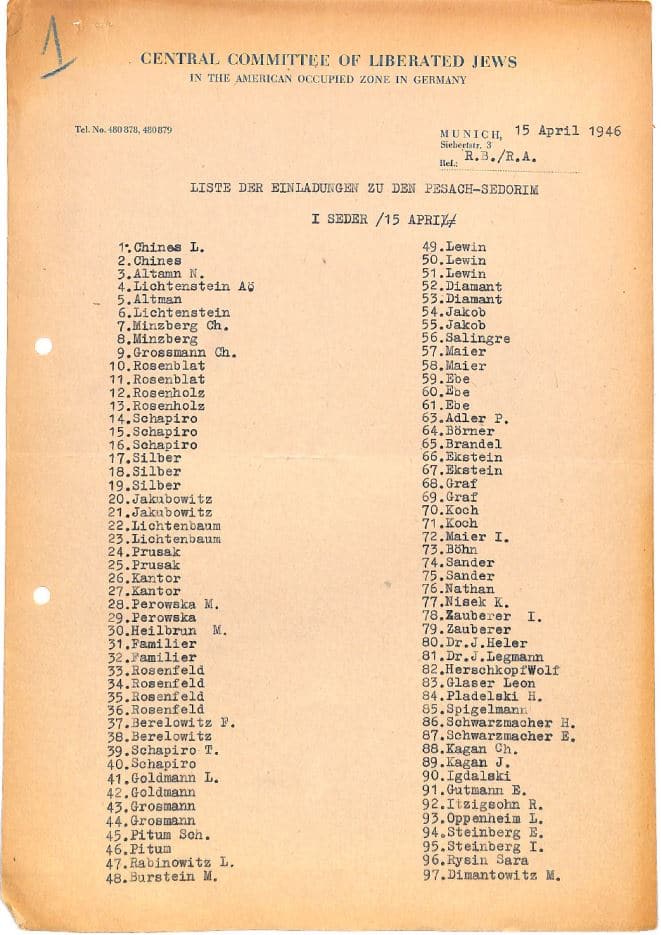
The invite list to the Seder conducted by Rabbi Klausner in the Munich Theatre, held on the same night as the Seder of the displaced persons camp in Munich, is preserved in the Central Archives for the History of the Jewish People. The list shows that only a few of the five hundred participants of the Passover Seder conducted by Rabbi Klausner were Holocaust survivors. The majority were soldiers in the U.S. armed forces.

A partial list of the invitees to the Passover Seder of the U.S. Army in Munich

The letter A was stamped on the title page of Rabbi Klausner’s private copy, indicating it belonged to the U.S. Army. On the same title page is the date and the location of the Seder at which the Haggadah was used: Munich, Germany, April 15-16, 1946″.

The title page of the Haggadah

Rabbi Klausner’s personal copy is currently stored in the Haggadah Collection of Aviram Paz. It was lent to the National Library for its “Next Year We Will Be Free Men” exhibition – an exhibition of unconventional Passover Haggadot from the years leading up to the founding of the state.

Related Articles:

How Communist Jews Made the Haggadah as Red as the Blood in the Nile

The Partisan Poet Rescued from the Woods of Lithuania

The Benghazi Haggadah: How the Jews of Libya Celebrated Victory Over the Nazis


`;