The Widow, the Rabbi, and the Bookseller

A Jerusalem bookseller, a rabbi under Soviet rule, and a widowed rabbanit from the Land of Israel all meet at the National Library… No, this is not, of course, the beginning of a joke, but rather the story of an archive preserving documents that are much more than just pages and postcards.

Rabbi Yehezkel Abramsky, against the backdrop of an envelope from one of his letters to Michel Rabinowitz. From the Michel Rabinowitz Archive, the National Library of Israel

Autumn 1927. One of the greatest rabbis in Eastern Europe takes an interest in the well-being of a widow he has never met.

Winter 1942. A young, childless widow is sent, together with the residents of Daugavpils, Latvia, to a killing site deep within the territory of the Nazi Reich. She was not supposed to be there.

February 1948. A Jerusalem bookseller kneels on the blood-soaked pavement of Jaffa Road, gathering charred pages from books that, only the day before, had stood on the shelves of his small shop.

Many years after these events, the life stories of these three people become intertwined in the form of carefully filed letters preserved in one of the National Library’s archives.

The Bookseller

On February 22, 1948, a massive explosion shook Ben-Yehuda Street in central Jerusalem. A truck bomb destroyed three buildings and killed some sixty people. The following day, a man could be seen kneeling amid the ruins, gathering charred, bloodstained pages from what remained of the “Darom” bookshop.

It was the shop’s owner himself – Michel Yitzhak Rabinowitz.

Rabinowitz was born in 1879 in the town of Mir, then within the Russian Empire. He had always been a man of words. As a young man, he was already known as a prodigy. He studied at the yeshivas of Telz and Slabodka and received rabbinic ordination. At the same time, he was among the early members of the Zionist movement, and articles he wrote were published in the Hebrew press of Eastern Europe.

After his marriage, he moved to Minsk, where he began dealing in new and antiquarian books at the shop of his father-in-law, Meir Heilperin. But books were not merely “merchandise,” and before long the shop had become a lively cultural center, attracting young people and intellectuals from throughout the surrounding area. When he was not at the shop, Rabinowitz was active in several Jewish and Zionist organizations. This activity led to his repeated arrests and eventually to his dismissal from his position as a lecturer at the government-run teachers’ seminary for Yiddish teachers.

In 1925, a few months after the death of his wife, Rabinowitz immigrated to the Land of Israel with his three daughters and settled in Jerusalem. By one means or another, he managed to bring his private library out of Russia with him – a remarkable collection of manuscripts and rare books that became the foundation of the “Darom” bookshop he opened on Ben-Yehuda Street. The inspiration for the new shop’s name came from the Talmudic dictum pointing people who seek wisdom towards the position of the Menorah in the holy Temple. “One who wishes to become wise should turn southward.” The shop offered Jerusalemites an impressive selection of old and new books, displaying sacred texts alongside works of literature and general learning.

Dedication written by Michel Rabinowitz on a joke notebook he gave to Judge Bardaki. 1937–1938. From the Michel Rabinowitz Archive, the National Library of Israel

As in Minsk, the shop soon became a place of pilgrimage for scholars, writers, and intellectuals, while Rabinowitz himself became deeply involved in the cultural and literary life of the Yishuv. He gave a regular Saturday lecture on Maimonides at Yeshurun Synagogue, spoke on a wide range of subjects on the “Kol Yerushalayim” radio station, and was active in numerous organizations, including the Meḳitẓe Nirdamim Society, which continues to this day to publish scholarly editions of foundational works and rare texts from the Jewish literary canon.

One Jerusalemite, the writer S. Y. Agnon, who was a friend of Rabinowitz, eulogized him in these words:

“The late Rabbi Michel Rabinowitz was an exceptional scholar, well versed in every corner of Torah. There was no area of Torah that he did not engage with. Old and new books were always open before him, at every time and every hour… He, too, had original Torah insights, but he never committed them to writing… I said to him, ‘Write your words in a book and publish them in print.’ He stretched out his hand toward all the books that filled the shelves of his shop and pointed to them, as though saying: ‘Who am I to come after them?’”

A unique figure, with one foot firmly planted in the Lithuanian yeshiva world and the other in the worlds of Jewish enlightenment and Zionism, Rabinowitz maintained an extensive correspondence throughout his life with rabbis, writers, and intellectuals from across the Jewish world. His archive was deposited at the National Library by his daughters in 1985, offering a rare window into the lives, thoughts, and struggles of the people of his time.

Michel Rabinowitz’s travel document from the period of the British Mandate. From the Michel Yitzhak Rabinowitz Archive, the National Library of Israel

The Rabbi

One of the central figures in Rabinowitz’s correspondence was Rabbi Yehezkel Abramsky, a leading rabbi of Lithuania, who would later serve as a rabbi in London and Jerusalem. The letters focus primarily on Rabinowitz’s efforts to bring Rabbi Abramsky’s writings, Hazon Yehezkel, to print, as well as on attempts to arrange his departure from Soviet Russia, where he felt isolated and cut off from the world of Torah, and where he faced a very real threat, if not to his life, then at least to his freedom.

“After all, your shop also serves as a meeting place for scholars and students of Torah,” Rabbi Abramsky wrote to Rabinowitz in a 1928 letter preserved at the National Library. “Surely your ears have heard various opinions there concerning my book Hazon Yehezkel. I, sitting here alone and isolated within four cubits of Torah, wish to know whether there are those who seek to praise this sacred work, which is the passion of my life. And if they seek to criticize it, for what reason and from what perspective do they speak? […] Perhaps my book has received no attention at all from the scholars of the Land of Israel? For worse than those who praise or criticize is the one who does not examine it at all. […] Forgive me, my friend, if I have wearied you this time with my words. I simply have no one with whom to discuss this matter, and so I have poured out my thoughts before you. After all, you alone, and no one else, have taken an interest in my work.”

From Rabbi Abramsky’s letter to Michel Rabinowitz, preserved in the Michel Rabinowitz Archive at the National Library of Israel

As persecution by the Communist authorities intensified, Rabbi Abramsky sought to leave Russia. Rabinowitz appealed on his behalf to the leaders of the moshava of Petah Tikva, who were, at the time, looking to appoint a new rabbi. In the correspondence concerning these efforts, a poignant human moment emerges: Rabbi Abramsky asked the leaders of the moshava about the circumstances of the widow of the previous rabbi, Rabbi Yisrael Abba Citron (a copy of the letter Rabbi Abramsky sent to the leaders of the moshava was enclosed with his letter to Michel Rabinowitz):

“It would give me great pleasure to know how secure the situation is of the rabbanit, widow of the late rabbi. My heart is, of course, confident in your noble spirit and kindness, that you have surely shown compassion toward both the living and the departed. […] Surely, my dear friends, you have seen fit to put her mind at ease in this matter, so that, God forbid, she should not have to worry about her livelihood in her widowhood. And when I, too, know the details of this matter and that all is well, my peace of mind will be complete.”

The Widowed Rabbanit

Rabbi Yisrael Abba Citron (Kitroni) was born in Daugavpils and attended both a heder and elementary school as a child. At the age of fourteen, he left his parents’ home to study at the yeshivas of Telz and Volozhin. Upon his return, he married Rachel, the daughter of Rabbi Yosef Rozen, known as the “Genius of Rogachov.” Although he received offers to serve as rabbi in major European cities, in 1911 (Hebrew year 5671) he chose instead to settle in the small moshava of Petah Tikva, saying, “Better to be a rabbi in a small village in the Land of Israel than in a great city abroad.”

Rabbi Citron’s business card from his tenure as rabbi of Petah Tikva. From the Levi Yitzhak Schneerson Archive, the National Library of Israel. This item is part of the Reinhard-Poʋmbronski Collection documenting the early history of Zionism, and was made accessible with the support of Eli and Janet Reinhard.

Rabbi Citron served as rabbi of Petah Tikva for approximately seventeen years and died suddenly in 1927, at the age of just forty-six. He and his wife, Rachel, had no children, and under Jewish law, Rachel was therefore required to undergo halitzah with one of his brothers before she could remarry.

But as if the pain of childlessness and the death of her husband were not enough, the brothers refused to perform halitzah. Both had abandoned the Jewish way of life: one had converted to Christianity, while the other, who did not believe and observed no religious way of life, lived in Bolshevik Russia. They may have disagreed about many things, but on one matter they were in complete agreement: they opposed the religious rite of halitzah.

And so the widowed rabbanit remained an agunah, unable to remarry and without a source of income.

When Rabbi Abramsky learned of Rabbi Citron’s death, he was deeply concerned for his widow. Above all, he wanted to ensure that his arrival to serve as the town’s rabbi would not undermine the community’s support for her.

Epilogue

In the end, Rabbi Abramsky’s appointment as rabbi of the Petah Tikva moshava did not come to pass. The Soviet authorities refused to grant him an exit visa, and he was arrested on charges of “anti-Soviet activity” – meaning, his desire to immigrate to the Land of Israel. After considerable efforts and pressure brought to bear by religious leaders across the Jewish world – from Rabbi Chaim Ozer Grodzinski to Chaim Nachman Bialik – Rabbi Abramsky was released on condition that he leave the Soviet Union permanently. The terms of his release were acceptable to all concerned.

Rabbi Abramsky was deported to Latvia, and only many months later were his wife and two of their children able to join him. His two eldest sons remained behind for many more years, a source of anguish documented in numerous letters the rabbi wrote to Michel Rabinowitz, many of which are also preserved in the archive. In the winter of 1931, Rabbi Abramsky settled in London, where he served as a rabbi for approximately twenty years. Only in 1951, following his retirement, did he immigrate to Israel and settle in Jerusalem.

Poster announcing Rabbi Abramsky’s arrival in the Land of Israel, from the Pavezner Collection, the National Library of Israel

Rabbanit Citron remained an agunah for the rest of her life. The halitzah case sparked a halakhic debate concerning the validity of halitzah performed by an apostate or an atheist. Following her husband’s death, Rabbanit Citron continued to live in Petah Tikva, supporting herself on a meager pension provided by the moshava committee. She later decided to publish the writings of her husband and those of her father, known as the “Rogachover.” To this end, in the 1930s she returned to Latvia and settled in the city where she had married and which she and her husband had left many years earlier: Daugavpils.

In 1941, most of the city’s Jews were murdered in the Pogulyanka Forest, and in the winter of 1942, the Nazis rounded up the remaining Jews in the ghetto and murdered them as well. Among those killed was Rabbanit Rachel Citron.

Pogulyanka Forest, where most of the Jews of Daugavpils were murdered in 1941–1942. Photograph courtesy of the St. Petersburg Institute of Jewish Studies, the Pritzker Family National Photography Collection, the National Library of Israel

The owner of the archive in which these letters were preserved, Michel Rabinowitz, struggled to recover after the attack that destroyed his bookshop. He no longer had the strength to rebuild the shop and start over, and he died, deeply grieved, just a few months later. After his death, it became clear that Rabinowitz had kept his most valuable books at his home in Jerusalem’s Rehavia neighborhood. His daughters decided to donate these books, along with his archive, to the National Library.

Decades after his death, the Jerusalem Municipality commemorated Rabinowitz and his legendary bookshop by naming a nearby alley Rehov Darom (“Darom Street”), after the name of his shop.

The stories of Michel Rabinowitz, Rabbi Abramsky, and Rabbanit Citron are woven together through the letters, documents, and pages preserved in a single archive. Today housed at the National Library, the archive allows us to encounter once again the intersection and the the people behind the historical events – their emotions and their everyday struggles – in their own voices, words, and handwriting.

The Michel Yitzhak Rabinowitz Archive is currently being cataloged and digitized at the National Library. Large portions of the archive have already been digitized and are available to the public through the National Library’s website.

‘You never knew when there was going to be a pogrom’

Why my grandfather left Europe

Victims of the Khorkov Pogrom, 1919. From the Pritzker Family National Photography Collection at the National Library of Israel

When I was six years old, I listened with fascination as my oldest brother interviewed our maternal grandfather, Isidore Weisner. As the youngest in the family, I sat cross-legged beneath the kitchen table, the only place in our cramped kitchen where I could find a spot.

“Grandpa, why did you leave Europe?” my brother asked.

“The pogroms, the pogroms were terrible, and you never knew when there was going to be a pogrom. I didn’t want to live that way, so I left.”

Grandpa died when I was 11, and in the half century since then, the questions I would have liked to ask him have multiplied exponentially. By studying life in Galicia, particularly for young men at the turn of the 20th century, I have begun to better understand the reasons why my  grandfather, like so many others, left his family and the country of his birth.

My grandfather was born in 1889 to Abraham Wiesner and Rose Fleisig. They lived in Kulikow (now Kulykiv, Ukraine), which was just north of Lemberg, Galicia’s provincial capital. Abraham worked as a grain merchant, a common occupation for Galician Jews. At that time, roughly 35% of Kulikow’s inhabitants were Jewish. My grandfather was the youngest of a large family. All his siblings later perished with their spouses and children in the Holocaust, except for one nephew.

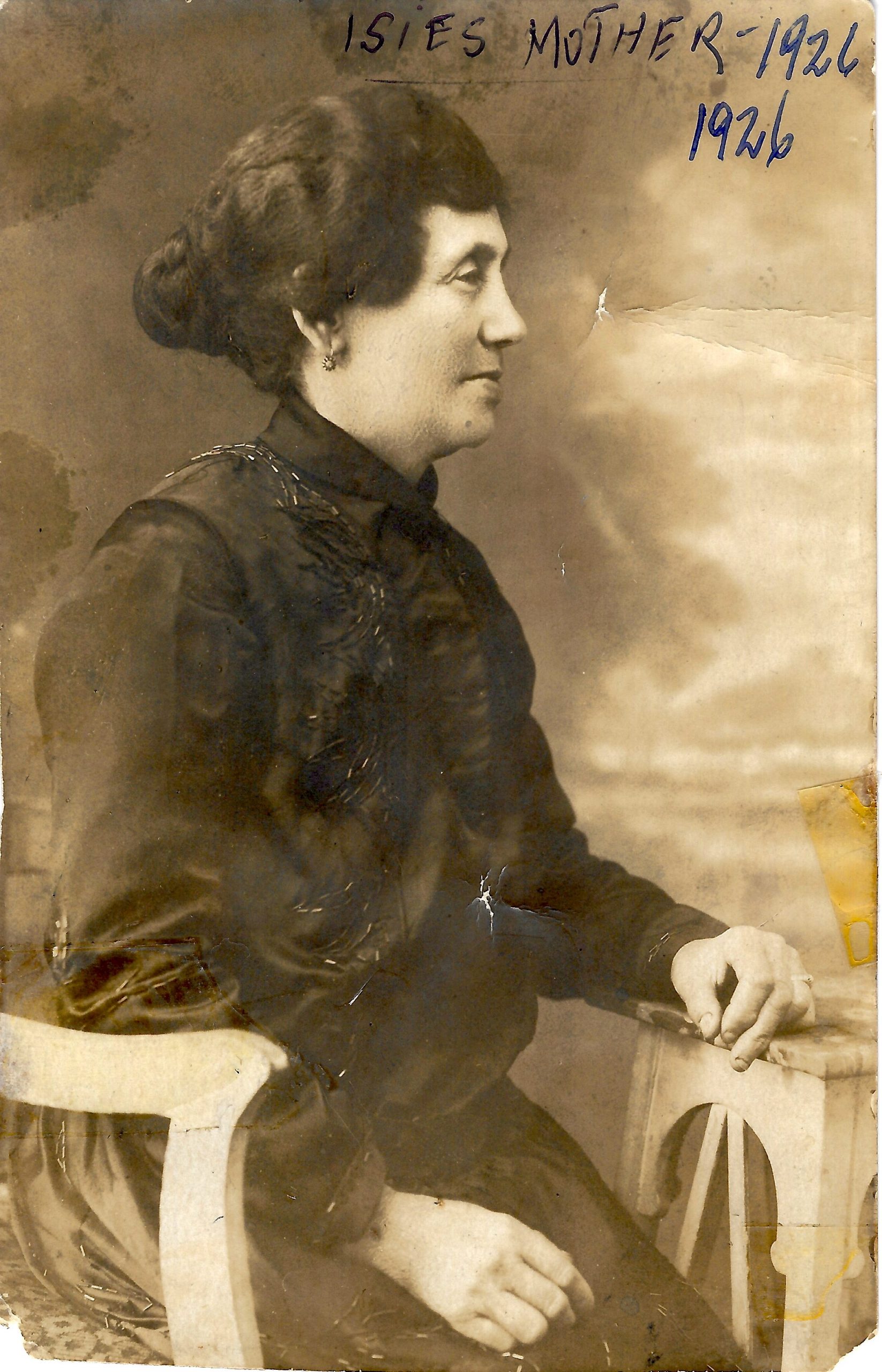
Isidore Weisner’s mother Rose in Kulikow, 1926. Inscribed on the back of the photo in German: “A memento from your mother.” (Courtesy: Sharon Taylor)

But long before the cataclysm, in December of 1908, my 18-year-old grandfather left his home and made the long journey to Rotterdam, where he boarded a ship bound for Ellis Island. On the ship, with his funds dwindling, he befriended a well-to-do family who paid him to look after their young children. He spent the 12-day crossing teaching the children to play chess, a skill that has been passed down in my family through generations. He arrived in New York on January 5, 1909, where immigration officials recorded his name as Asryel Wiesner. Sometime after his arrival, eager to sound more American, he changed his first name to Isidore and the spelling of his surname to Weisner.

While most Jews left Galicia in the late 19th and early 20th century to seek better economic opportunities, my grandfather’s decision to emigrate was motivated by anti-Jewish violence. During his childhood, anti-Semitism was on the rise across the crownland. In the spring of 1898, when my grandfather was nine, The Standard of London reported “bread riots” in Lemberg which were quickly crushed. Although hunger was the motive there, the riots spread west and began to target Jews. Just 81 miles (130 kilometers) away in Przemysl, rioters entered the Jewish section of the city, ransacking Jewish homes and shops.  Despite Austrian military intervention, the attacks in Przemysl became so violent that on May 29, The Observer of London reported that “the entire Jewish population has fled.”

Jews and uniformed officials in Przemysl, ca. 1900. From the Folklore Research Center, Hebrew University of Jerusalem; part of the National Library of Israel Digital Collection

Throughout the spring and early summer of that year, anti-Jewish riots continued, mostly in western Galicia. Jewish homes were looted and then set on fire. Christians placed crucifixes, candles, and figurines of saints in their windows in an attempt to save their homes. The military was called to control the violence, but the rioting didn’t subside until the end of June when the equivalent of martial law was proclaimed in several of the most affected districts.

Unlike the pogroms of 1898, most Galician pogroms were local events that were never reported in English-language newspapers. In his book Shtetl Memoirs, author Joachim Schoenfeld gives several accounts of how more localized violence was a daily threat underlying Jewish life in Galicia around the turn of the century. In his hometown of Sniatyn (present-day Snyatyn, Ukraine), Jewish boys rarely ventured from the Jewish parts of town, and Jewish wagon drivers moved their merchandise in groups to avoid becoming targets of violence.

Victims of the Bialystock pogrom, 1905. From the Pritzker Family National Photography Collection at the National Library of Israel

An unfavorable bargain in the market square or too much to drink at a wedding could easily turn into a pogrom, with peasants marching through the Jewish streets of the town yelling “Kill the Jews!” Jews were beaten, windows were broken, and shops were looted. Often, it was all over before authorities could arrive. According to Schoenfeld, the Jews of Sniatyn would spend the following days replacing windows and nursing bruises and broken bones, but it wasn’t long before the same peasants were back in the market square doing business with Jewish merchants as if nothing had happened.

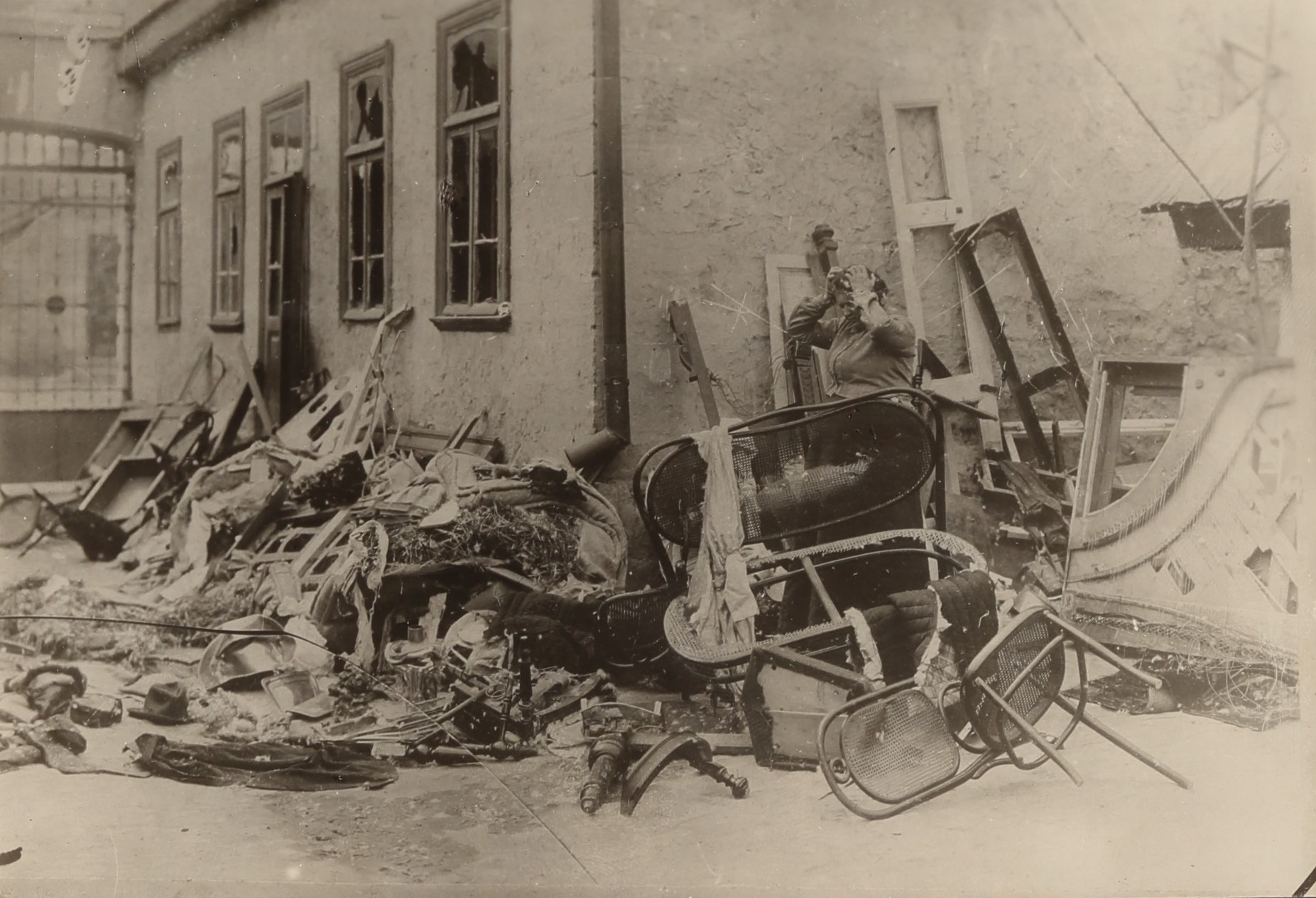
A woman surveys her destroyed and ransacked home following the Kishinev Pogrom, 1903.  While the Kishinev Pogrom elicited outcry from around the world, pogroms were a common occurrence throughout Eastern Europe, often garnering little attention outside of the immediately impacted community. From the Pritzker Family National Photography Collection at the National Library of Israel

It’s likely that this type of violence occurred in Kulikow, particularly around the time of the contentious election of 1907, which saw the National Democratic Party, with its anti-Semitic rhetoric, winning a number of seats in the Imperial Council in Vienna (the Reichsrat).

My grandfather began his journey to America the very next year. I will never know the details of the pogrom that caused him to leave Galicia, but if I could go back in time to that long-ago interview, that would be one of the first questions I would ask.


A variation of this article first appeared as part of “Leaving Galicia – Poverty, Pogroms, and Draft Evasion” in the March 2020 edition of The Galitzianer, the quarterly research journal of Gesher Galicia. It has been published here as part of Gesher L’Europa, the National Library of Israel’s initiative to share stories and connect with people, institutions and communities in Europe and beyond.


If you liked this article, try these:

Tolstoy and the Jews: It’s Complicated

When the ‘Jerusalem of Austria’ Burned to the Ground (on Lag B’Omer)

The Lost World of a Wedding Comedian – The Story of Avraham Horowitz

“Your rabbi was taken as a hostage”: Accounts of Russian Tactics in WWI

Hostage-taking and forced migration were just two methods used by Russian forces in Ukraine and Poland a century ago

Jewish burial near the Galician theater of war, 1915 (Public domain)

Following Russian advances into portions of Ukraine and Poland in 1914, stories of atrocities quickly spread throughout Europe and beyond. At first, the accounts from Jewish communities were almost too horrific to believe: Packs of Russian Cossack and Chechen soldiers stealing whatever they liked, raping women and girls in the streets in front of their families, cutting off limbs for sport, even crucifying men who dared to speak out against their beastly acts. Others were hung by their tefillin.

The veracity of the stories was sometimes questioned, especially, for example, when promulgated by Ukrainian nationalist elements, though the sheer number of reports and diversity of sources soon dispelled any doubt that war crimes were being committed.

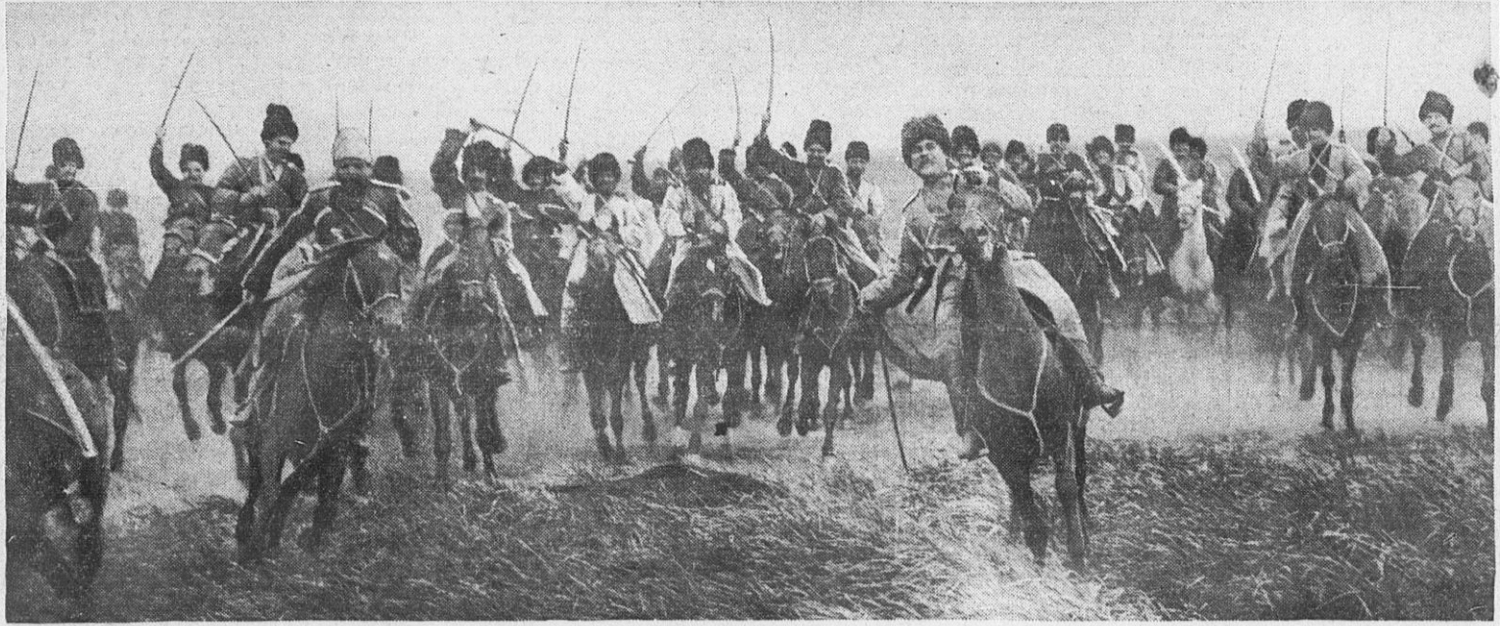
“Wild Charge of The Most-Feared Troops in the Army of the Czar, The Cossacks” photo published in the Evening Public Ledger, March 1, 1915 (Library of Congress / Public domain). Click image to enlarge

In many cases, Russian authorities opted for hostage-taking instead of murder or forced expulsion. They would identify and detain prominent Jews from each community – rabbis, businessmen, civic leaders – and then warn the local community that the hostages would be killed should any acts deemed disloyal be committed.

“Your rabbi was taken as a hostage. If we hear again that Jews have talked to Germans the rabbi will be hanged,” a resident of the Polish town of Myszyniec (“Mishenitz” in Yiddish) recalled being told. Just two days later, the orders changed and all of the Jewish residents of the town were forcibly expelled, with only about half a dozen Jews, including a few over the age of 90, staying behind. In many cases such decisions were made at the field commander level, yet patterns and similar methods were certainly seen throughout the conflict zone.

When the Russians conquered Czernowitz (“Chernivtsi” in Ukrainian), the capital of Bukovina, they demanded that the Jewish mayor, Dr. Salo Weisselberger, hand over prominent citizens to be held hostage. Weisselberger reportedly refused, saying that he had no control over anyone but himself. He was subsequently sent to Siberia where he remained even after Austro-Hungarian forces recaptured the city, though he ultimately returned home following a prisoner exchange and was knighted by Austrian Emperor Franz Joseph.

Main Street, Czernowitz, 1903. From The Joseph and Margit Hoffman Judaica Postcard Collection; available via the National Library of Israel Digital Collection

Czernowitz during the 1917 visit of Emperor Franz Joseph’s successor, Karl I (Austrian National Library / Public domain)

Bukovina and neighboring Galicia – multi-ethnic regions that straddle today’s Ukrainian, Polish and Romanian borderlands – saw especially fierce fighting during the war. Hotbeds of Ukrainian culture and education, Ukrainians in these areas were accused by the Austro-Hungarians of being pro-Russian, while the Russians cracked down on local Ukrainian nationalists by mean of imprisonment, expulsion and murder.

Meanwhile, deep-seeded antisemitism, mistrust and geopolitical interests, ensured that accusations of treason and disloyalty against Jews persisted across Europe. The realities of Jewish life and loyalties at the time, though, were far from clear or predictable. Jews, in fact, served and sacrificed on all sides, despite such allegations. The Russian, Austrian and American armies each had hundreds of thousands of Jews among their ranks, not to mention the numerous other nations engaged in the conflict.

German Jewish soldiers and their families, 1914. From The Joseph and Margit Hoffman Judaica Postcard Collection; available via the National Library of Israel Digital Collection

Nevertheless, the Jewish civilian population suffered greatly, especially at the hands of Russian commanders who often expelled Jews from the towns and cities they called home simply because of their communal affiliation. They were generally forbidden from bringing their possessions with them into forced exile. With no truly comprehensive statistics available, scholars estimate that during the course of the war, between half a million and one million Jews in the Russian Empire were forcibly expelled from their homes. Scholar Jonathan Frankel has even estimated that some 1,000,000 Jews were already expelled by the end of 1915.

In an excerpted letter published early that year, one exile from the town of Skierniewice recalled his personal experience:

“We were not even permitted to leave behind us the sick and the women in childbirth. Only the Jewish bakers, blacksmiths and a few contractors were allowed to remain. But they did not care to stay and prepared to leave with the rest of us…

The Poles did not even wait for the Jews to leave town before they started plundering our homes and shops. They met with no resistance. The Jews, of course, were powerless…

It was the Sabbath, but the rabbis declared it lawful to set the children, the feeble old men and the women in childbirth on wagons, which we hired at unheard of prices. We took the scrolls of the law in our hands and, amid savage cries of the Poles and the soldiers, we left the town in silence and despair… Even the children cried with us…

The worst part of our experience was, however, that all along the way we were continually joined by ever new hosts of Jews who were even more destitute than we. The livelong day we dragged ourselves along the hard, rutty roads. Besides us moved long lines of Russian soldiers. They were coming to ‘redeem’ the land from the hands of the enemy and it was these redeemers who inflicted upon us the most excruciating woes. Wherever the Russian troops went they were accompanied by a crowd of Poles, men and women and children, who would point at us and shout: ‘There go the traitors!’… ‘Go to Palestine, you accursed Jews!’ the Poles and the soldiers would taunt us…”

A report published later in 1915 described forced expulsions deep into Russian territory as far as the Ural Mountains and Siberia as “an awful picture of the most abject misery”. Train cars packed mostly with Ukrainian Jews, Lithuanians and “other inhabitants of the war zone,” were “filled beyond their capacity… the people are heaped indiscriminately in piles, old men and women, children, sick people, all of them worn out and exhausted by a long journey lacking all human comfort… all of these people are in rags…”

The reporter further described the prisoners as “hav[ing] been shipped like merchandise or worse, like cattle. They are numbered and each one carries his bill of lading. They are not human beings they are treated like a shipment of freight.”

This heap of humanity had been traveling for weeks, having no idea where to go. “It matters little where we are sent to, as long as it only brings us nearer to death,” one of the prisoners bemoaned.

Jewish refugees from Poland head towards safety across the Austrian border, October 6, 1915 (Library of Congress / Public domain)

While many of their brethren were sent eastward, thousands of Jewish refugees descended upon major cities across Europe. Just a few months into the war, the Vienna Jewish community, for example, was already feeding kosher meals to some 8,000 refugees each day. In Warsaw, thousands arrived daily, packing communal institutions. Hundreds of people, mostly women and children, even slept in the Zamir literary club, founded and headed by legendary Yiddish author Y.L. Peretz, who cared for them personally. Wall-to-wall beds stuffed the club’s main hall, which looked like an “ant colony that had been destroyed,” according to S. Ansky, the famous scholar and author of The Dybbuk, in his book The Destruction of the Jews of Poland, Galicia and Bukovina. The refugees had come “mostly by foot, robbed, naked, starving, faded by fear and helplessness,” Ansky recalled.

According to historian Peter Gatrell, “for decades the only publication of note in Russian relating to population displacement in the era of the First World War was a brief and tantalising encyclopedia entry on ‘refugeedom’ by Abram Kirzhnits in the first edition of the Soviet historical encyclopedia.”

Kirzhnits termed concerted Russian efforts to massively displace diverse civilian populations a ‘bacchanalia of forced migration’. While “Jews in particular suffered from widespread antisemitism,” according to Gatrell, the forced migrations “ensnared Poles, Jews, Latvians, Lithuanians, Belarusians and Ukrainians… targeted on account of their presumed disloyalty to the empire.”

This “bacchanalia of forced migration” deeply impacted 20th century history, while its effects – and causes – continue to echo in Ukraine and well beyond its borders.


This article has been published as part of Gesher L’Europa, the National Library of Israel’s initiative to connect with people, institutions and communities across Europe and beyond, through storytelling, knowledge sharing and community engagement.

`;