Survivor, Olympian, Scientist: Shaul Ladany’s Long Walk

He survived the Holocaust and the massacre of Israeli athletes at the Munich Olympics, broke world records, published books and still walks daily at 90.

832 629 Blog

Israeli race walker Shaul Ladany in action, 1977, photo by IPPA staff, the Dan Hadani Archive, the Pritzker Family National Photography Collection at the National Library of Israel

When air-raid sirens sounded in the previous days and weeks to indicate incoming ballistic missiles launched against Israel by Iran, Shaul Ladany didn’t get flustered. He just walked into the safe room of his house in Omer, near Beer Sheva, and closed the door.

Ladany, who celebrates his 90th birthday on April 2, 2026, has experienced worse in his long life. Far worse.

User Comments
Shaul Ladany in 2019, photo by Ehud Amir

He lived through the Shoah as a boy in Yugoslavia. He had close calls as an Israel Defense Forces soldier. As an athlete competing at the 1972 Olympics in Munich, West Germany, he escaped harm as Palestinian terrorists raided Israel’s dormitories and murdered 11 of his teammates. He survived a serious car accident and a stroke.

“I don’t get excited by all this,” Ladany said by phone of the latest Israel-Iran war.

“It reminds me of 85 years ago, in 1941, when the Germans bombed our home in Belgrade. Of course, there were no air-raid sirens [then]. Our villa had a big basement, a laundry room and a garage. We went into the laundry room, and suddenly there was a big BOOM. The door was blown off. My grandmother lay atop me to save me. The door fell onto her and didn’t harm her.

“Neighbors entered our basement because they thought it would be safer than their own basement. All of them were killed.”

Ladany’s father, an officer in the engineering corps, then was on reserve duty along the border with Albania, so Ladany’s grandfather took control of the situation. Their car wouldn’t start, so the family — which included Ladany’s mother and his cousin, an orphan whom he always considered a sister — walked to the home of friends, who paid a farmer to house the Jews in his horse stable.

Ladany survived the Bergen-Belsen concentration camp and reached Israel in 1948. After serving in the IDF, he studied industrial engineering and became a professor at Ben-Gurion University of the Negev.

As a master’s student at Hebrew University of Jerusalem, Ladany was drawn to race walking, an obscure specialty within track and field (also known as athletics) in which a competitor always must have one foot remain in contact with the ground. He became very good at it — world-class, in fact. He competed in the 1968 and 1972 Olympics.

Flickr Government Press Office (gpo) The Winners Of The 10,000 M Walk
Shaul Ladany standing atop the podium after winning the 10,000 meter walk at the 8th Maccabiah Games held in Ramat Gan, Israel, August, 1969, photo: GPO

In 1972, in New Jersey, he set a world record in the 50-mile (81 km.) distance, a mark that still stands: 7 hours, 23 minutes, 50 seconds. That same year, in Switzerland, he won the 100-kilometer (60-mile) world championship in 9:31:00. He won gold medals in five Maccabiah competitions and took 28 Israeli titles.

The May 26, 1972, Edition Of The Australian Jewish News (melbourne)
From the May 26, 1972, edition of The Australian Jewish News (Melbourne), the Historical Jewish Press Collection at the National Library of Israel

As an older man, Ladany continued competing and racking up championship medals in his age groups in race walking, walking marathons and swimming in Israel and abroad.

He authored an autobiography published in Hebrew in 1997 and in English in 2008, King of the Road: From Bergen-Belsen to the Olympics Games — The Autobiography of an Israeli Scientist and a World Record-Holding Race Walker. He was inducted in 2012 to the Ramat Gan, Israel-based International Jewish Sports Hall of Fame.

“His spirit is contagious and his accomplishments are unmatched, not just in Israel but [amongst] athletes around the globe,” said Jed Margolis, the hall’s president.

Uri Afek, an administrative member of Israel’s 1972 Munich delegation and Ladany’s longtime friend, called him “an important and successful athlete” in Israeli history.

The February 16, 1973, Edition Of The San Francisco Jewish Bulletin
Ladany had some outspoken views about the aftermath of the terror attack at the 1972 Olympics, from the February 16, 1973, edition of the San Francisco Jewish Bulletin, the Historical Jewish Press Collection at the National Library of Israel

That is especially so, Afek pointed out, when considering both the hours a race walker competes when compared to, say, a soccer match of 90 minutes and Ladany’s combination of athletic and professional success.

“He’s someone special, no doubt about it,” Afek said.

The August 31, 1972, Issue Of The Jewish Week
This report was published six days before the massacre at the Munich Olympics began, in the August 31, 1972, edition of The Jewish Week, the Historical Jewish Press Collection at the National Library of Israel

About a decade ago, en route to Germany for a commemorative event at Bergen-Belsen, he was felled by a stroke, which had previously taken the life of his wife, Shoshana. That slowed Ladany, but only somewhat. Last year, he competed in a 5K walk race. These days, he exercises up to two hours daily, including walking in ovals at home.

“I have no physical ailments,” he said. “I’m vegetarian, don’t smoke or drink coffee, don’t eat bad food. I didn’t gain weight. I probably weigh 70 kilos [154 pounds].”

Ladany’s strong, animated voice and his whimsy have weakened noticeably in the 11 years since we last met. He’s sold off some of his multiple collections, such as his postcards of the Zionist visionary, Theodor Herzl, and decorative pins from the World Zionist Congress. He has a caregiver. Understandably for a widower of 90, he is lonely. A physician living in Paris, a native of Novi Sad, was his last remaining first cousin, and now she’s gone.

“I have friends I speak with on the phone, who also are very old,” he said. “So many have died: those I served with in the army, studied with in high school and at the Technion, friends in Omer. There are not that many people my age anymore.”

Ladany chuckled.

שאול לדני
Shaul Ladany, still walking. Photo by Ofer Berger

For his big birthday, Ladany’s daughter, Danit, wanted to throw a party. He declined. He’s heard through the grapevine that the university’s engineering department is planning a bash of sorts. That would be okay by him.

A friend already provided a birthday gift: a volume of stories Ladany has told, some involving his own life. When he retired, Ladany’s university colleagues presented him with a two-volume set of his scientific and academic articles.

Asked how turning 90 strikes him, Ladany returned to where the conversation began.

“I don’t get excited by anything,” he said.

“In my refrigerator, I have chestnut spread, which my daughter bought when she was abroad,” he said. “I will wait until my birthday to eat some.”

Writer-editor Hillel Kuttler can be reached at [email protected].
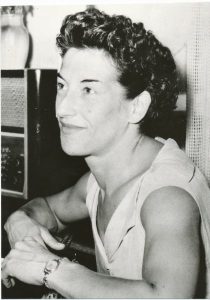
The entire State of Israel may have racked up just one Olympic gold medal in its short history, but Ágnes Keleti, a resident of the Israeli city of Herzliya, is the proud owner of no less than ten Olympic medals – five of them gold.

Keleti was born on January 9, 1921 in Budapest to a well-to-do Jewish family. At the tender age of 4, Keleti began taking “swimming lessons” thanks to her father, who enjoyed tossing her into the lake during family vacations. She was also enrolled in gymnastics at a young age. Despite showing obvious physical talent, Ágnes did not begin to take the sport seriously until age sixteen. Instead, she spent most of her time practicing and playing the cello.

Unlike many other athletes, whose distinct competitive drive pushes them to compete at an international level, Keleti says it was not necessarily her hunger to win medals that motivated her.

“The medals were nice, but I didn’t play sports solely for the accolades. I enjoyed the day-to-day routine and the opportunity to see the world. The Communist regime in Hungary was very tough and not at all to my liking. At the time, most people could not even leave Hungary. I decided to excel in sports in order to see the world. I was fortunate enough to visit places that most people didn’t even dare dream of,” she said in an interview several years ago.

Ágnes Keleti, from the Maccabiah Archive
From the Maccabiah Archive

Keleti survived the Holocaust by using a false identity. During the war years, she adopted the name “Yuhasz Piroshka” and assumed the identity of a village maid. Later, she worked in an ammunition factory. Her mother and sister were also saved, thanks to the famous Swedish diplomat Raoul Wallenberg, who was later recognized as one of the Righteous Among the Nations by the State of Israel. Unfortunately, the same luck did not extend to the rest of her family. Her father and uncles were murdered at Auschwitz.

When the war ended, Keleti returned to gymnastics. In 1946, she won the title of ‘Hungarian National Champion,’ which she held until she fled the country in 1956. Her meteoric rise to world fame came at the 1952 Helsinki Olympics. At the age of 31, Keleti won four medals: a gold medal in floor exercise, a silver medal in the all-around team competition, a bronze in the uneven bars and a bronze in the portable apparatus team event.

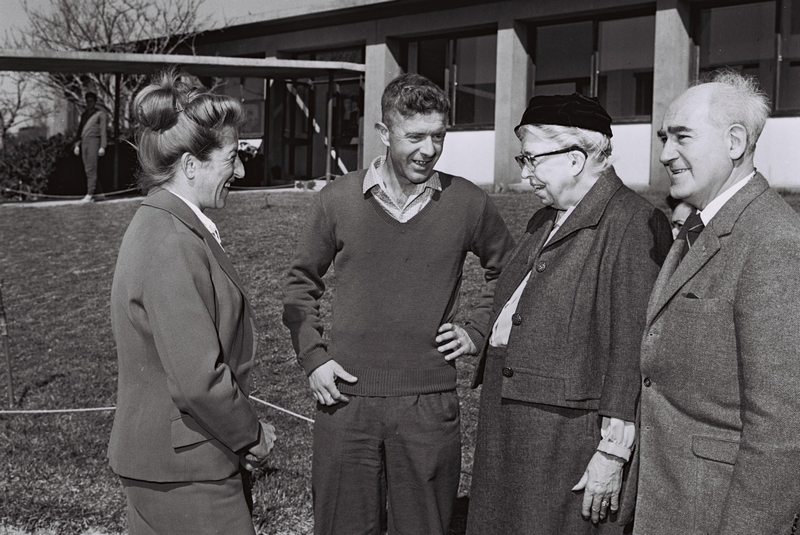
אגנס קלטי (משמאל) עם אורי זמרי, ברוך בק, ואלינור רוזוולט 23.2.1962, צילום: לע"מ
Ágnes Keleti (left) with Uri Zimri, Eleanor Roosevelt and Baruch Beck – February 23rd, 1962, photo: GPO

In 1956, she competed in the Melbourne Olympics, this time at the age of 35 (twice the age of most of her competitors). She won six medals in Melbourne: three gold medals in individual events (floor, uneven bars and balance beam), another gold in the portable apparatus team event and two silver medals in both the individual and team all-around events.

By the end of her career, Keleti had won ten Olympic medals overall, placing her seventh in terms of all-time medal winners in Olympic history. For comparison, the legendary Carl Lewis also has ten medals to his name, while Mark Spitz has eleven medals in total. In fact, Ágnes Keleti holds more medals than other familiar sports legends like Nadia Comăneci and Usain Bolt. Yet what is perhaps most impressive about Keleti’s medal run is that she won nine out of her ten Olympic medals after reaching the age of 30.

Escape from Hungary and Immigration to Israel

While Keleti was halfway across the world competing in the Melbourne Olympics, a national rebellion was brutally put down by the Soviet regime in her native Hungary. When the revolt broke out, Keleti made the difficult decision not to return to the country for which she was competing. Together with other Hungarian athletes, she appealed to the Australian government for asylum. Their request was granted.

In fact, Keleti had already begun plotting her escape from Hungary prior to her departure for the Melbourne Olympics: “I had had enough of this bloody regime. One day I was swimming in the national team’s heated pool and a young man offered to drive me home. I agreed, but after a while I noticed that we weren’t heading in the direction of my house. He took me to the communist party headquarters and, there, they tried to convince me to spy on my teammates. In that very moment, I realized that I must escape” she told an interviewer.

Although she was an international Olympic star, Keleti was unsuccessful at finding acceptable work in Australia. One day, she received a telegram from Professor Gifstein, her physical education teacher from the Jewish gymnasium in Budapest. In the telegram, he told her that he had decided to immigrate to Israel.

עיתון "דבר" 25.8.1957
“Introducing: Ágnes Keleti” Davar, August 25th, 1957


Gifstein invited her to come to Israel to continue her training while adding a warning: “There is nothing here. Bring equipment with you.” Keleti decided to accept his invitation nonetheless and arrived in Israel in 1957, just in time to participate in the Fifth Maccabiah Games.

From the Tel Aviv Municipality Collection

The press in Israel was very excited by Keleti’s arrival in the country. Because of her success at the previous Olympics, she became one of the biggest stars of the Fifth Maccabiah. The stands were packed as Ágnes Keleti took to the floor, this time in her new home of Israel.


Agnes Keleti passed away on January 2, 2025, shortly before her 104th birthday. May her memory be a blessing.


`;