

No one knows for certain how Abu Jilda, the notorious highwayman, was finally captured by the British Mandate Police. The accounts are many, and they often contradict one another. Some reports describe hundreds of policemen surrounding the cave where Abu Jilda and his companion, Armit, were hiding. According to one version, the location of their hideout was revealed by a young woman with whom Abu Jilda was romantically involved and who regularly visited him at the cave near his native village. Other stories claim that one of his own gang members betrayed him to the authorities. Still others insist that it was Abu Jilda’s brother who disclosed the outlaw’s whereabouts. Contemporary newspapers, however, reported that the informer was none other than his trusted right-hand man.
But it is hardly surprising that so many legends came to surround a man who styled himself the “King of Palestine” and succeeded in eluding the police for so many years. Even the exact year of his birth remains uncertain.
In the 1920s and 1930s, highway robbery was still a genuine danger for anyone venturing beyond the safety of established towns and villages in Mandatory Palestine. No highwayman was more famous – or more feared – than Ahmad Hamad al-Hamud, better known as Abu Jilda. Before long, he had established control over the countryside around Nablus, carrying out a string of audacious robberies that made him one of the most notorious figures of the period.
By the time they were captured in the remote cave, Abu Jilda and his accomplice, Armit, had been wanted by the British Mandate Police for nearly a year. A year earlier, Abu Jilda had captured a local police constable who had attempted to thwart one of his highway robberies. He tortured the officer before murdering him. Even before that killing, Abu Jilda was already a wanted outlaw who had repeatedly slipped through the grasp of the Mandate authorities, sometimes after armed confrontations with the police. Following the murder, the police offered a reward of 350 Palestine pounds for any information leading to his whereabouts or capture.
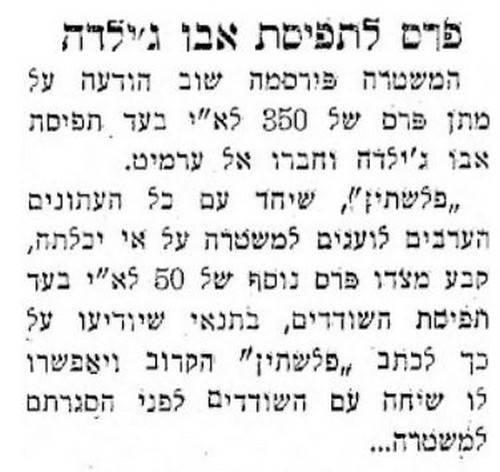
All attempts to capture Abu Jilda proved futile. On several occasions, the police laid siege with dozens and sometimes hundreds of officers to hideouts where the highwayman was believed to be hiding. The search even enlisted the aid of aircraft, but without success. As noted, long before he became a murderer, the authorities had already been trying to apprehend Abu Jilda for the many highway robberies attributed to him. He terrorized farmers throughout the Nablus District, the Jezreel Valley, Haifa, and the surrounding region: one day stealing a flock of sheep, another day making off with eggs and poultry, and so on.
His repeated clashes with the police and the authorities, during which he was said to have killed five policemen, transformed Abu Jilda in Palestinian folklore into a symbol of resistance against foreign rule. He came to be portrayed as a kind of Robin Hood, robbing the wealthy, embodying fearless defiance, and striking fear into all who crossed his path. Other bandits invoked his name to intimidate their victims, and countless legends grew up around his exploits. Folk songs were composed in his honor, and some of the best-known were said to be sung at nearly every celebration and wedding.
Yet Abu Jilda’s legend was not confined to Arabic-speaking Palestinians. His name also found its way into the stories and songs of the Jewish community in Mandatory Palestine. In a well-known dictionary of Hebrew slang compiled by Dan Ben-Amotz and Netiva Ben-Yehuda, documenting the vernacular of Israel’s early statehood period, the entry for “Abu Jilda” is defined as: “a brute, a criminal, an aggressive person (after the Arab bandit who led one of the gangs in the 1930s).”
The name became so deeply embedded in spoken Hebrew that even Moshe Dayan acquired the nickname “Abu Jilda.” As a child, Ariel Sharon dreamed of capturing the infamous highwayman. Abu Jilda appeared in at least two different folk songs, one of which described him as the “King of the Demons.” More than three decades later, his name was still a familiar cultural reference, even making its way into the screenplay of Ephraim Kishon’s classic Israeli film The Policeman (Ha-Shoter Azoulay).
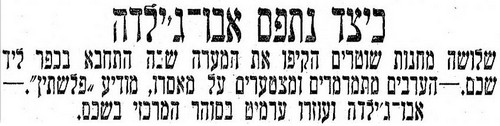
The media, too, showed no lack of interest in the intimidating outlaw who had repeatedly made the police look powerless. Arabic-language newspapers celebrated his image and frequently mocked the police for their failures. Hebrew newspapers reported on his exploits with concern and expressed hope that he would soon be captured. Meanwhile, the influential English-language newspaper The Palestine Post (precursor of The Jerusalem Post) even published a special interview with him, conducted at a location that was kept secret.

Abu Jilda himself willingly cooperated with the press. He regularly sent newspaper offices letters and photographs, demanding that they be published promptly, sometimes accompanied by threats.

Eventually, the highwayman and his close accomplice, known as al-Armeet, were captured without a single shot being fired and brought to trial. The trial lasted only one day, at the end of which the two men were sentenced to death. Their appeal was rejected, and the sentence was carried out.

In the days leading up to their execution, Abu Jilda was visited by Haim Dviri, a member of Lehi, or the Fighters for the Freedom of Israel, a Zionist organization founded in Mandatory Palestine in 1940, aimed at evicting the British authorities from the land to make way for a Jewish state. Dviri later described the unforgettable encounter in his Hebrew book A Spring Day That Will Not Be Forgotten (Yom Aviv Shelo Yishake’ach, published by Yair, 1986). Abu Jilda’s name continued to evoke fear for many decades afterward.