
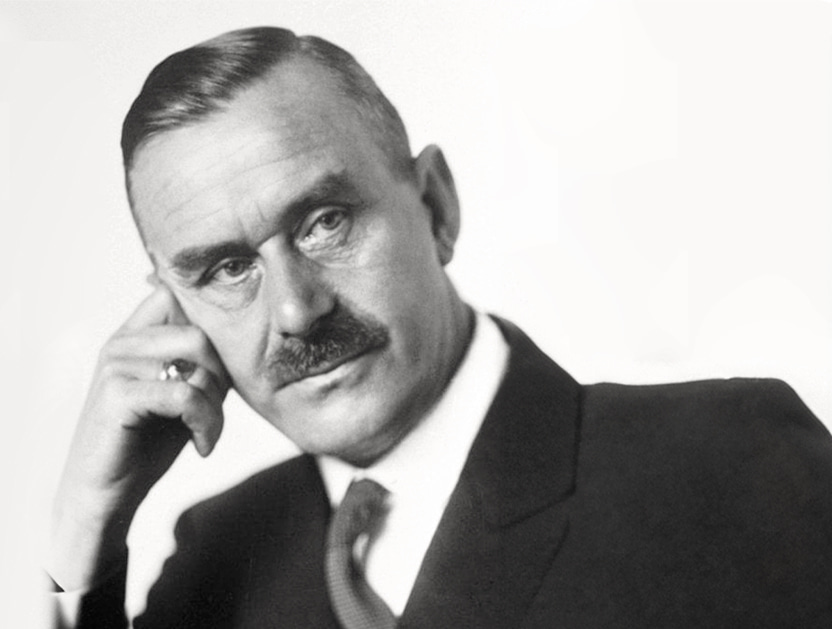
“Over the next 12 months I intend to send a series of 24 essays to the country [Germany], to be written by representatives of the German intellect for Germans. The series of pamphlets is not to have merely a political character, but to appeal to the sound instincts of our people, whereas Hitler knows only how to awaken the most dangerous instincts. A committee of American friends (headed by Dr. Frank Kingdon, President of Newark University) will finance the project, and during this year I will approach 24 German authors, scholars, theologians, and artists with various proposals [for contributions to the series – S.L.]. I request your agreement in principle to add your name, a name well-known and beloved in Germany and throughout the world, to the list of German intellectuals I have assembled. If you agree, I will send you further details soon.”
When Thomas Mann wrote these lines to Stefan Zweig in May 1939, he was living in exile in Princeton, New Jersey, much like other German authors who had been forced to flee Germany due to their anti-Nazi views or because of their Jewish origins. Most of them were respected and successful, yet the Nazi regime did not hesitate to expel them from the accepted canon of German literature.
Beloved of the German People
However, Thomas Mann was not just another author – he was the “prince” of German writers of his time, a revered figure whose books Buddenbrooks, The Magic Mountain, and Joseph and His Brothers enjoyed enormous popularity and critical acclaim. In 1929, Mann was awarded the Nobel Prize, mainly for the extraordinary success of his first novel, Buddenbrooks, a work about the decline and fall of a merchant family in northern Germany that is considered one of the most important books in the history of German literature. Although Thomas Mann’s style is not easy to read – written in long, complex sentences and in elevated language – his works sold in the hundreds of thousands, not only in German but in many other languages as well.
Thomas Mann was born in 1875 in the city of Lübeck in northern Germany, a trading hub since the Middle Ages. His father came from a respected and wealthy family, and his mother was of Brazilian descent. As a boy, Mann was not a diligent student and found his studies boring. He finished school without a high school diploma and moved to Munich, far from his family roots in northern Germany. In his youth, he wrote poetry and short pieces for various journals. In 1900 he was drafted into the army but was crafty enough to secure a medical discharge after only three months. Many years later, this experience became the basis for his novel Confessions of Felix Krull, Confidence Man.
Following the success of his first novel, and with the steady financial support from his father’s estate, Mann devoted himself to a writing career. In 1905, he married Katia Pringsheim, from a prominent Jewish bourgeois family in Munich. Katia brought Mann closer to Judaism, something that manifested itself on several occasions throughout his life.
Although Mann’s writings and private diaries reveal his attraction to men, he and Katia maintained a stable marriage for 50 years and had six children: Erika, Klaus, Golo, Monika, Elisabeth, and Michael – the first four of whom also became authors. Katia was also the inspiration for one of his most famous novels: In 1912, when she fell ill with tuberculosis and stayed at a sanatorium in Davos, Switzerland, Mann visited her there and found in that place the inspiration for The Magic Mountain, which takes place in a fictional sanatorium in the same Swiss town. Mann’s popularity rose together with the high regard for his work: The Magic Mountain was published in 1924, and in 1929 he won the Nobel Prize for Literature. Many of his works were published in bibliophile editions, in which he signed his name. The National Library holds a collection including several volumes with his signature.


A Post-Nobel Trip to the Land of Israel
Immediately after receiving the Nobel Prize, Mann traveled to Egypt and the Land of Israel to gather material for his next major novel, Joseph and His Brothers, and to experience the region’s geography and culture. During his visit, he went to the Hebrew University and also visited the Jewish National and University Library – the forerunner of today’s National Library of Israel. Mann met with the Library’s director, Shmuel Hugo Bergman, and on March 23, 1930, signed the Library’s guest book.

While in the region, Mann also encountered the less pleasant aspects of the Middle East: He suffered from food poisoning and was hospitalized in Jerusalem, with the incident even reaching the local press:

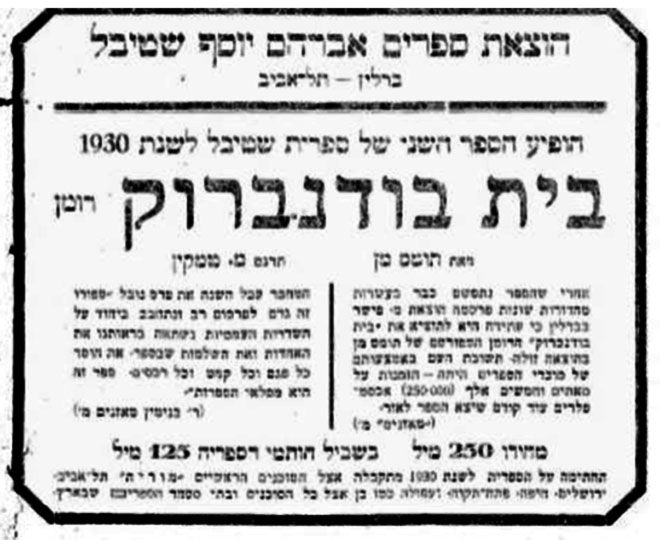
At that time, Hebrew translations of his works were also being published. The Stiebel publishing house released the first Hebrew edition of Buddenbrooks in the same year Mann visited Israel.

Mann was a proud German. During the First World War, he still supported Germany’s nationalist course and even severed ties with “pacifist” authors like Hermann Hesse and Stefan Zweig. But after the war ended, he distanced himself from these views, and during the years of the Weimar Republic, he became a public supporter of the new democratic regime in his homeland.
In Praise of Democracy, in Condemnation of Conservatism
In October 1930, after returning from his visit to Mandatory Palestine and in light of the Nazi Party’s great success in the elections held a month earlier, Mann delivered his famous German Address. In it, he condemned the anti-democratic tendencies of the Nazis and the political atmosphere that had allowed them to develop. This speech, together with Mann’s political positions, led the Nazis to place him on the Third Reich’s blacklist. In February 1933, shortly after the Nazis rose to power, Mann was in Switzerland with his wife. Rumors from Germany that the regime intended to arrest him upon his return led the couple to the unavoidable conclusion that they could not go back to their homeland. The Third Reich later confiscated all of Mann’s property, and he became an exiled author, first in Switzerland and, from 1938, in the United States. He continued to engage in various activities against the German dictatorship, such as the initiative mentioned in the quotation at the beginning of this article.

In addition to numerous public speeches, including on the BBC’s German-language radio program during the war, and political publications he put out over this period, Mann worked in every possible way to give voice to German intellectuals opposing the criminal existence of the Third Reich, its ideology and actions. His letters to various individuals, among them other contemporary writers, also bear witness to these efforts. Mann wrote tens of thousands of letters, many of which have survived and been published in scholarly editions. Today, the Thomas Mann Archive in Zurich is converting its letter collection into digital format.
The National Library of Israel also holds dozens of letters from the celebrated author. The largest groups are found in three personal archives: the Rudolf Kayser Archive, the Albert Ehrenstein Archive, and the Stefan Zweig Collection. Rudolf Kayser was the chief editor of an important German literary journal until 1933, resulting in the two being in touch and maintaining correspondence before and after that year.
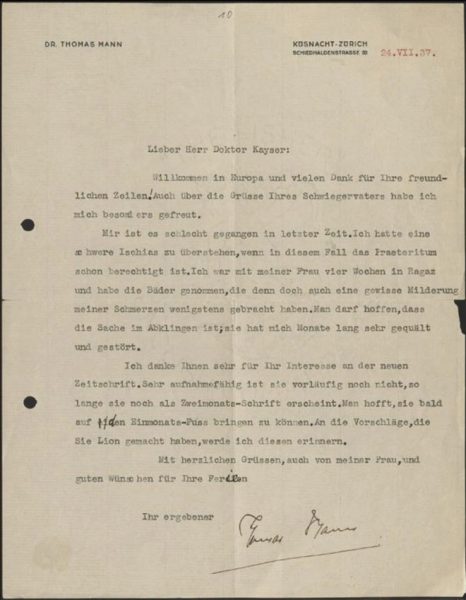
Mann valued direct contact with his readers, and often replied to the many letters he received from around the world. One such letter went to Jeannette Hannah Leibovitz (whose husband was a cousin of Yeshayahu Leibowitz) in 1948, when she was living in Motza, near Jerusalem. She had written to him earlier, emphasizing how much his readers in Israel appreciated the novel Joseph and His Brothers.
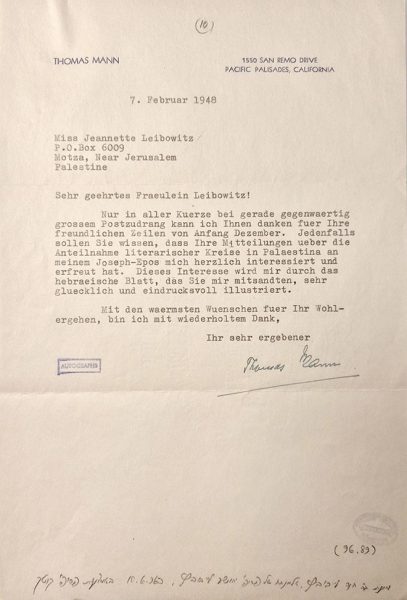
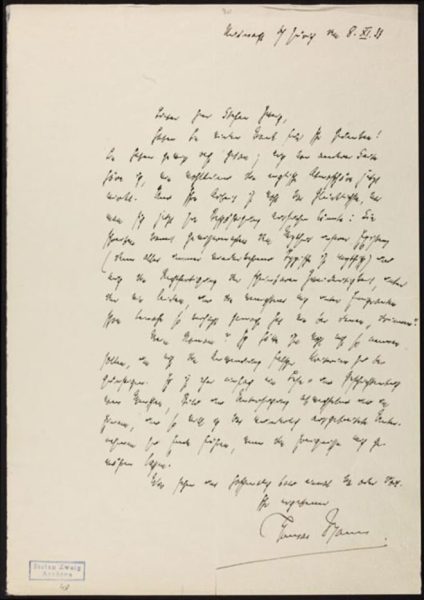
Mann maintained a long correspondence with author Stefan Zweig, although their relationship was somewhat tense. The two were in a subtle rivalry for the mantle of “most successful German-language author”. The Stefan Zweig Collection at the National Library preserves the letters Zweig received from Mann until 1933. Yet despite the tension, there was also much mutual respect. This can be seen in the fact that Mann wrote his letters to Zweig by hand, rather than typing them. On the other hand, this may have also been meant as a sort of challenge, as Mann’s handwriting was notoriously difficult to decipher, to the great frustration of his recipients.
At the end of World War II, Thomas Mann was living in California. He believed that Germany and the German people bore a shared responsibility for the crimes committed during the war. In his view, this collective guilt justified the destruction of German cities in the heavy Allied bombings as “the price that had to be paid.” He also declared that he would never again live in his homeland.
In the early 1950s, however, the increasingly conservative political climate in the United States prompted Mann to return to Europe, though not to Germany. He and his wife settled in the town of Kilchberg, near Zurich, Switzerland. Despite his reservations toward Germany, Mann visited his native country three times. The public received him warmly, though there were also voices critical of his opposition to the Nazi regime.
On August 12, 1955, the renowned author died at the age of 80. For most of his life, Mann maintained a positive and close connection to Judaism. This may help explain why his grave in Switzerland is always covered with numerous small stones.