

Hadassa Goldvicht hadn’t been to a local library in a while, so she drove to one in Jerusalem a few years ago. While she browsed in the stacks, a voice on her phone blurted, “You’ve reached your destination.” It was an app’s traffic-navigation system, which Goldvicht forgot to shut off after parking her car.
The announcement was doubly right: Goldvicht realized she’d gotten to where she was meant to arrive creatively, too. And so, the Jerusalem video artist has made books’ repositories the subject of an exhibition, To the Internal Libraries, which opened in August and may be viewed through February 2026 on the National Library of Israel’s main floor.

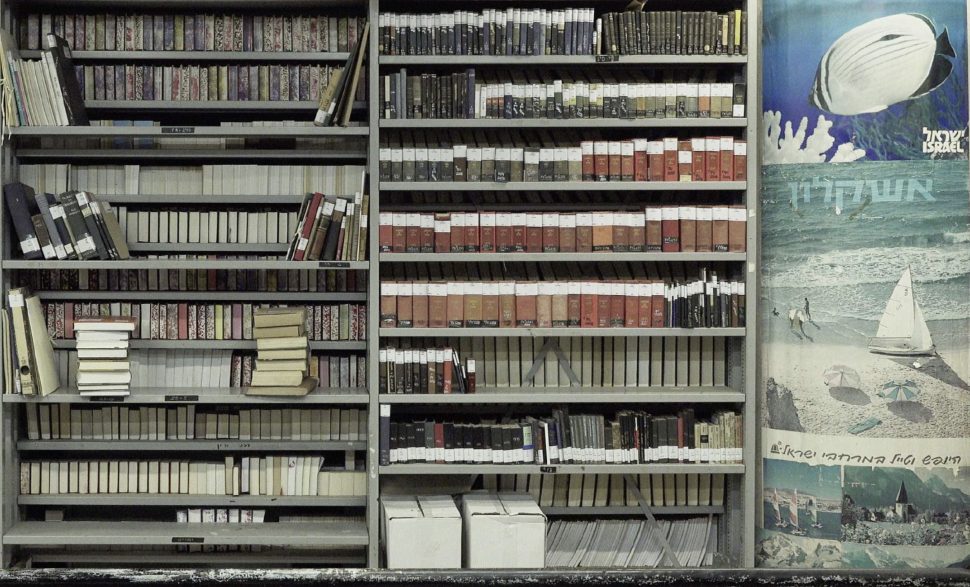
It consists of four video screens showing the bowels of NLI in its previous location, at Hebrew University’s Givat Ram campus, in the years just prior to the Library’s move in October 2023 to a new building opposite the Knesset. On the first screen, we see part of the path upon a conveyer belt that a book took from a shelf to a patron. Another screen shows facing shelf units compressing and expanding to allow access to librarians. A third takes us on a journey past the sides of the units as we linger on each row and down it, trying to grasp the enormity of the range of titles. The final is a variation of the previous screen, but the camera gradually pulls back until the book-laden shelf units on both left and right end and the camera reveals the next units bereft of all books and, further back-back-back, still more units in states of disassembly pre-move — and then, as if the camera operator’s back had hit a bumper, the journey propels us forward, the disarray yielding to the empty shelves until reaching the full shelves as they are meant to be, where the loop sends us backward and forward yet again. A fifth installation isn’t a video but a moving, six-meter (20-foot) section of one of the library’s green conveyor belts that Goldvicht purchased.

People don’t appear in Goldvicht’s works, no words are spoken and no sounds are audible other than the images’ musical accompaniment. But all are implied: Patrons, of course, had ordered the books; librarians took the requests, located the items and placed them on the conveyer belts — and, hours or days or weeks later, people repeated the process in reverse to return the books to their assigned locations. While no one is seen, we can’t miss the posters of Ashkelon and Haifa’s Bahai temple and other places that the stacks’ workers adhered to the shelf ends as their personal signatures of sorts. Words aren’t uttered on film, but trillions of them fill the books. We don’t hear the belt’s movement, but surely it made noise, as did the shoes of librarians treading kilometers upon kilometers daily to fulfill the orders, and the freight elevators delivering them vertically off the belts.

The films reveal a process patrons never saw at Givat Ram — or, probably, at any enormous library. Now, in NLI’s technologically-advanced building, a visitor can stand at windows to observe robotic arms, not librarians, fetch someone’s requested publication and send it on its way.
The exhibit neither documents the move from old building to new nor sentimentalizes the previous location, but it honors an effective system of the past that brought knowledge, enjoyment and employment to generations of the library’s readers and employees.
As such, Goldvicht explained, it represents broader themes of transition and change, deconstruction and reconstruction.
She had more in mind than a behind-the-scenes look at the operation of a vast repository of 4.5 million books, 2.5 million photographs, more than 600,000 manuscripts and 200,000 newspapers. Indeed, Goldvicht even maintained that the exhibition “is not about the National Library.”
“The bigger picture is that it is about language, the way we interact with it. I feel it’s almost about trying to break something down to its basic components. It’s about trying to distill, understand, something about these transitions, the process of healing and what it requires. For me, the process of healing is all connected and very much informs this work,” she said in fluent English.
Pain and healing are themes Goldvicht raised throughout a more-than two-hour conversation in the Library’s cafeteria and in the exhibit’s two rooms. She spoke of work on the exhibit coinciding with her giving birth and being treated for chronic pain, of coming to see both the Library and the body as multifaceted systems whose secrets can be tapped through knowledge. A book accompanying the exhibit includes the transcript of her discussion with a Hadassah Hospital physician whose treatment plan helped to cure Goldvicht’s ailments.
Goldvicht said in the book that she learned to look inward to become healthy again.
“That is, in fact, the core of the recovery process — your return to ‘the books’ within you, to the natural knowledge contained within you,” the physician, Efrat Suraqui responded.
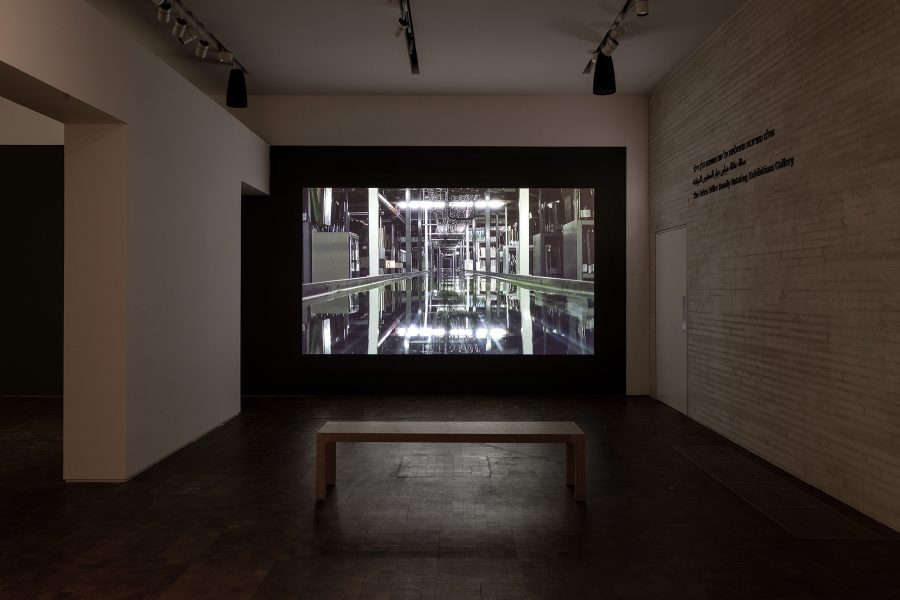
In the interview for this article, Goldvicht said a library is akin to a human body whose systems function unobserved, interdependently. The library has a pulse — the heartbeat suggested by the video’s rhythmic opening and closing of the shelves. She described her investigation of a book’s trek from subterranean stacks to a reader as a “catheterization.”
Goldvicht gave as an example her filming of a book’s — in actuality, her film camera’s — journey on a conveyor belt.
The belts stood many meters above the floor. Goldvicht didn’t know what her filming would reveal of the journey until retrieving her camera.

“We are surrounded by endless knowledge,” she said. “There’s something about this show that calls you back in to see our internal libraries, our body of knowledge.”
You can book your tickets to visit To the Internal Libraries, the new exhibition at the National Library of Israel, here, and learn more about Hadassa Goldvicht’s work at: hadassagoldvicht.com.
Writer-editor Hillel Kuttler can be reached at [email protected].