

In the late 1980s in their Hollywood Hills home in Los Angeles, Kathleen Beller went upstairs so her husband Thomas Dolby, a music producer, could start working with the singer who had just arrived and would be staying with them for a few weeks. Minutes later, she was back.
“She heard this voice filling the house and came down. The voice was so luminous,” Dolby, now a music professor at Baltimore’s Johns Hopkins University, said in a late-January telephone call. His wife, he said, had expected to find their guest standing in the middle of the room, projecting like an opera singer. Instead, the two were merely sitting on the sofa reviewing lyrics.
The singer was Ofra Haza, a pop star in her native Israel.
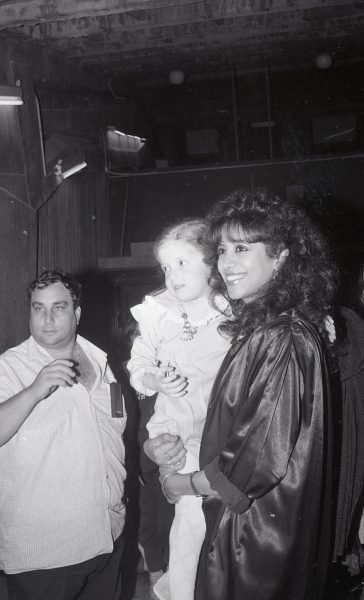
“It was surprising because Ofra managed to emote with her voice without needing to belt. Great singers are like that,” said Dolby, who would know, having worked with such talents as David Bowie, Joni Mitchell and Foreigner.
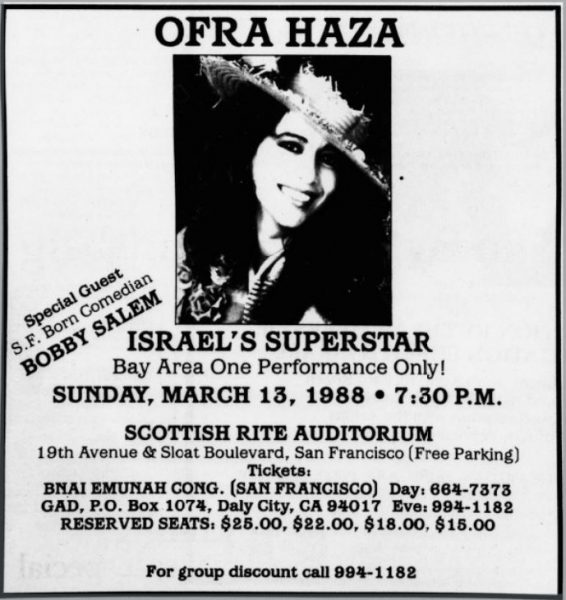
With her career evolving, Haza had come to the United States to record albums and perform in languages other than her native Hebrew. The album Dolby coproduced, Desert Wind, was one of several of that period that Haza recorded in English, Arabic and Aramaic in honoring her Yemenite roots. In Hollywood, she also sang on movie soundtracks, notably Dick Tracy and the animated film The Prince of Egypt.
On her first full day in the city, Haza was in tourist mode, visiting Universal Studios and the Santa Monica beach. Dolby recalled her excitement at shopping on posh Rodeo Drive but returning having purchased only a pair of sneakers — which, he said, “always looked white, brand new,” thereafter because of her polishing.
Haza enjoyed living in Los Angeles, according to her longtime manager, Bezalel Aloni, but was Israeli through and through. Haza telephoned her parents regularly, he said, and yearned to return home. She did just that, and in 1997 got married.

She died just three years later, at age 42, of AIDS — news that shocked Israelis. Haza reportedly was infected by her husband, Doron Ashkenazi, a drug user. She passed away on February 23 in 2000.
It was a stunning end to the career and life of a beloved figure, a singular talent with a pure voice, radiant smile and charm who’d burst onto the world stage from humble beginnings in Tel Aviv’s HaTikvah neighborhood and at age 25 represented the country in the prestigious Eurovision Song Contest, where she finished second by singing “Chai” (Alive).

Haza attributed her musical inclinations to her mother, Shoshana, who sang professionally in the latter’s native Yemen; Ofra was the only one of the family’s nine children born in Israel. Dolby told of recording “Fatamorgana,” on the Desert Wind album, and encouraging Haza to call her mother back in Tel Aviv to ask her to sing some of the lyrics, which he incorporated in the song. That happened after Haza mentioned to Dolby a traditional Yemenite technique, wail-like, that Shoshana employed.

“We managed to get her to sing in the key of the song, and it just fit, so it’s a very touching moment,” Dolby said.
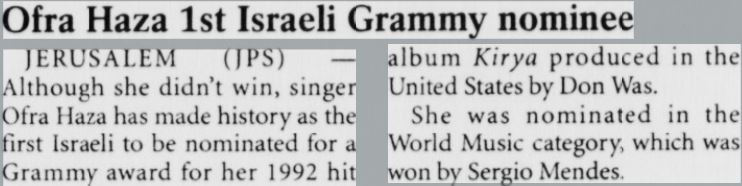
Three of Haza’s greatest Israeli albums — Adama (Earth), Shirei Moledet (Songs of the Homeland) and Yamim Nishbarim (Broken Days) — oozed with songs of Zionism, spirituality, romantic love and yearning. Then there were Fifty Gates of Wisdom (also called Yemenite Songs) and Shaday, one of the names of God, that melded Yemenite tradition and Western dance beats, and broadened her appeal internationally. Kirya earned a Grammy nomination, an Israeli first; Don Was produced the album, which included Haza’s duet with Iggy Pop on “Daw Da Hiya.”
Frank Peterson, who produced Ofra Haza, the singer’s 1997 album – it would be her final one – at his studio in Hamburg, Germany, said she was “really driven, really professional, really good and an amazing singer.” The two worked together quickly and efficiently over a period of approximately 25 days on five trips Haza made to Hamburg, he said.
A year after Haza’s death, Peterson flew to Israel and placed a stone on her grave. “I still really miss her,” he said. “It was one of those work experiences you don’t forget.”
One of my pleasant journalistic and musical experiences was attending Haza’s appearance at the 9:30 Club in downtown Washington, D.C., in April 1992. The tiny venue was packed with young people having a grand time on the dance floor as Haza sang from a slight platform a few yards away.

Above the din, I asked one couple what made them so enthusiastic for Haza, given that most lyrics were not in English.
“Her music crosses borders,” the man responded.
Aloni was there that night, as for much of Haza’s career. Their pairing began when Haza was just 12½ and a man in Aloni’s neighborhood musical-theater troupe recommended the girl he’d heard sing at a bar mitzvah the day before.
Haza stopped by Aloni’s apartment the next day as he and his wife, Ogenya, ate lunch. She declined their invitation to join them at the table, instead standing and singing “Im Tashuv” (If You Return).
Aloni immediately recognized her talent.
“You know what? I got the chills. This young girl. I looked at her and asked her to return at 6:00 p.m. for rehearsals,” Aloni said recently by phone from his home in central Israel. “She came and sat there. She then got on the stage, and she knew all the words. She filled in for a young woman who got sick.”
Listening in during the interview, Ogenya corrected him, saying that Haza substituted for a man who couldn’t make it to a performance.
Haza matured with each show and was the troupe’s only member to appear in each production, Aloni said. Soon, ahead of a song contest, Aloni met the event’s producer and talked up his protégé, who was waiting in the car with Ogenya, as an entrant. Haza entered and sang “The Sabbath Bride.” The producer laughed and quickly answered, “Okay, okay!” to affirm that she could enter the show. Recalling these events, Aloni sang the song over the phone. He continued: “The audience loved it. She won first place. It was in Jerusalem. It was her first national appearance. People started writing about her.”
Over the ensuing three decades, Haza’s talent took her and the Alonis all over the world. Aloni mentioned their being in Rio de Janeiro when Argentina won the 1986 World Cup, and the three of them joining the street celebrations. They once flew to an appearance in the Tokyo Music Festival and sat in first class, courtesy of the organizers, next to popular British musicians, whose names he didn’t recall.

“We disembarked from the plane, and there were so many people. Ofra said, ‘Wow, they’re waiting for the Brits.’ But guess who they were really waiting for: Ofra Haza,” he said.
“We’d say all the time: Who’d believe that music would take us from the HaTikva neighborhood to these places? What experiences we had!” he continued.
Aloni turned wistful, bemoaning Haza’s premature death. He said that Haza, who died childless, dreamt “about being the mother of a little girl.”
And, as if summoning “Someone Who Always Walks Beside Me,” a gorgeous ballad on Haza’s Earth album, Aloni added: “She’d always say, ‘God will watch over me.’ ”
Writer-editor Hillel Kuttler can be reached at [email protected].