
By Noa Reichmann
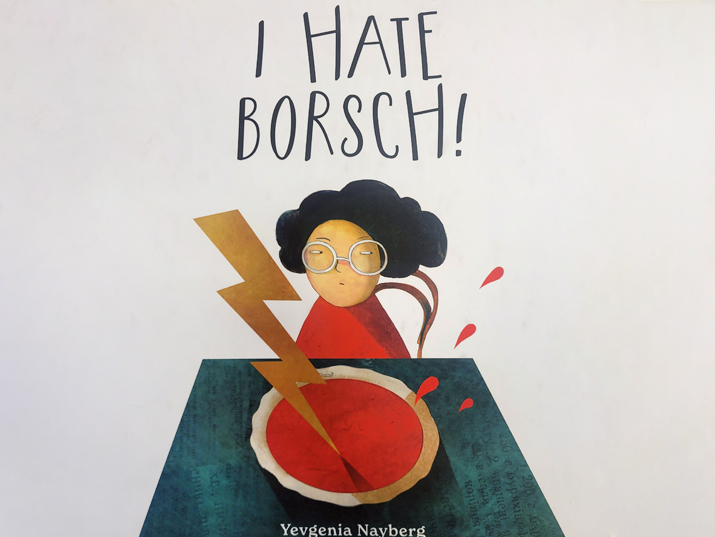
“All Ukrainians are supposed to love borsch(t)—but what if you hate the red stuff? A young girl despises Eastern Europe’s most beloved soup, and not even the grandmothers of Kiev can persuade her to change her mind…”
From the cover of I Hate Borsch!
Yevgenia Nayberg, an award-winning theater designer, author and illustrator, grew up in Ukraine and immigrated to the United States.
As a Ukrainian girl, she was expected to love sour beet soup, otherwise known as borsch or borscht – but what to do, she really can’t stand the “red, thick, disgusting soup!” With many a humorous illustration, she describes her excitement at all the elements of Ukrainian agriculture being enlisted in the service of making this national dish. Her sense of persecution is also translated into amusing, brightly colored illustrations.

While preparing to leave for the United States, Yevgenia receives many recipes for making borscht, and every grandma she knows swears her own recipe is the one true original. Arriving at the Promised Land of America teaches her new things about the hated dish: it’s called borscht there rather than the Ukrainian “borsch”, it comes in bottles and has no taste at all…

Moving to the US exposed Yevgenia to new foods and tastes. But as time passed and after eating “tons” of American food, she felt something was missing. Maybe she missed the sight of the red liquid in the white ceramic bowl, the heavy crooked spoon on the wooden table, or the “amber tea in the cloudy glass”. After opening up her old suitcase and taking out her old children’s clothes, she took the borsch recipes, laid them on the table, read them one by one, and then went to the kitchen to prepare the dish.

The book ends, naturally, with the author’s own recipe for borsch.
Unfortunately, many Israeli citizens have also had to recently leave their homes, and not out of choice. Some of them don’t even have any souvenirs of their former lives, which were turned upside down in a day.
The National Library of Israel collections include recipe books produced in various communities around the country, many of them in kibbutzim.
Because of the character of life on the kibbutz in the past, most of the recipes in the older books refer to baked goods: cakes, cookies, and salted pastries. There are also recipes for salads and other dishes appropriate for hosting guests, but usually not recipes for whole meals.
This was the case with a publication released by the “Baking Mothers Organization” of Kibbutz Nahal Oz in 1985. An absolute majority of its recipes cover cookies and cakes.
The online cookbook put out by Kibbutz Be’eri in 2022 is representative of kibbutz life in the 21st century. It includes recipes for all parts of the meal: starters, soups, main dishes, and desserts. It contains traditional foods from different Jewish communities, alongside foods from around the world: sushi salad with seaweed alongside Hungarian goulash with nokedli or couscous soup.
The very mention of some dish we knew in the past always has an emotional connection – of rejection, or of longing.
May the dishes, morsels and recipes we encounter only conjure up pleasant memories!
Translated from Hebrew by Avi Woolf