

Once again this year, the National Library of Israel joins the people of Israel in marking Jerusalem Day on the 19th of Iyar. Or is it, perhaps, the 23rd of Tammuz? The 25th of Elul? Could it be the 12th of Adar? Or, in fact… the 28th of Iyar?
Is it possible that there’s more than one “Jerusalem Day”? And which was the original? I set out to investigate.
The phrase “day of Jerusalem” (Yom Yerushalayim) first appears in Psalm 137:
“Remember, O Lord, against the children of Edom, the day of Jerusalem, who said: Raze it, raze it, even to its foundation.”
Many assume this refers to the destruction of the Second Temple by the Romans—often identified in Jewish tradition as the “children of Edom.” But this psalm actually refers to the destruction of the First Temple. In this famous chapter, the Israelites sit by the rivers of Babylon, mourning their ruined Jerusalem. It is here that we also find the iconic verse: “If I forget thee, O Jerusalem, let my right hand forget its cunning.” The psalm continues with an appeal to God to remember the Edomites, who had rejoiced at the Jews’ downfall and wished for Jerusalem to be razed so thoroughly that not even its foundations would remain.
In other words, between the lines, we discover that in biblical times, “Jerusalem Day” was in fact a day of mourning.
The 23rd of Tammuz
Now fast-forward two thousand years: the idea of Jerusalem Day as a day of grief took on a new expression in 1946. On the 23rd of Tammuz, 5706 – July 22, 1946 – a powerful explosion shook Jerusalem. The Irgun (Etzel) underground organization blew up the southern wing of the King David Hotel, which housed the British Mandate military headquarters. Explosives concealed in milk cans caused much of the hotel to collapse. Although Irgun members attempted to issue evacuation warnings, they were not fully successful, and the blast killed between 80 and 100 people, according to various estimates – 17 of them Jews.
Much of the Yishuv – the Jewish community of Mandatory Palestine – was shocked by the attack and its heavy death toll, which included many innocent civilians. The explosion not only destroyed part of the hotel, it also shattered the already tenuous cooperation among the Jewish underground movements. A deep rift opened between the Haganah and the Irgun, and the united Jewish Resistance Movement was dissolved. The terrible day left a deep imprint on the consciousness of the Yishuv and in the newspapers of the time, a phrase reemerged – “Jerusalem Day” – now invoked in memory of the bombing and its victims.
Here, for example, is how HaBoker, the newspaper of the General Zionists party, reported on the bombing and the public reaction to its casualties:

The 12th of Adar
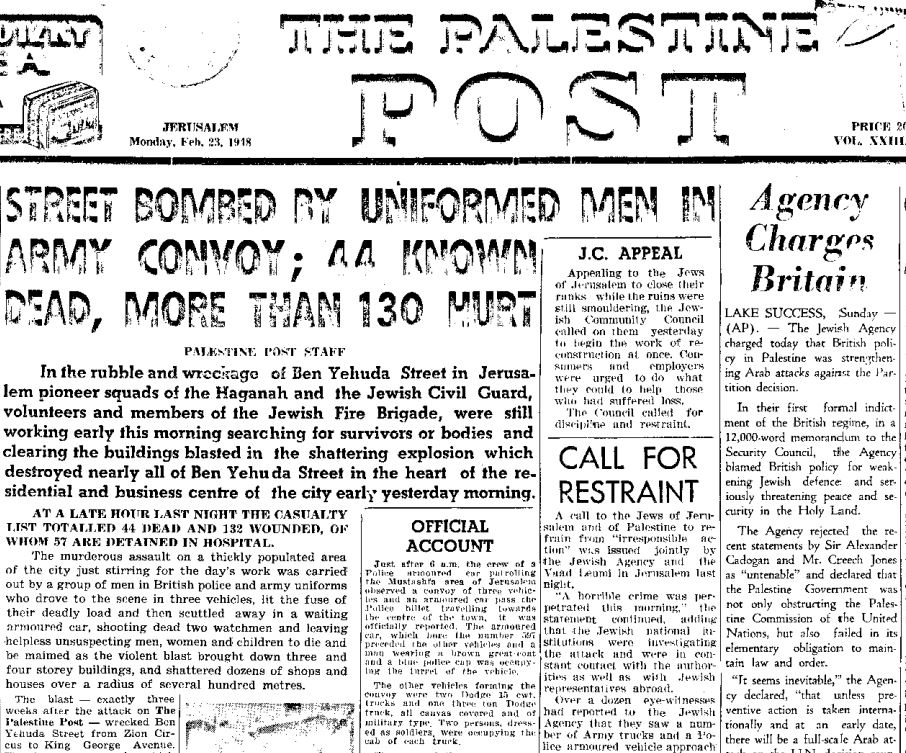
As with the previous case, this date was also intended to mark a day of mourning for a bombing. But whereas the King David Hotel explosion had divided public opinion, this time the entire Jewish Yishuv was united in grief. On the 12th of Adar, 5708 (February 22, 1948), at 6:30 a.m., three explosive-laden trucks driven by deserters from the British army arrived on Ben Yehuda Street in central Jerusalem. After the drivers fled the scene, the trucks exploded, destroying nearby buildings and killing dozens of city residents.
The Yishuv was stunned. The large number of casualties—some of them refugees temporarily housed in hotels after their homes were destroyed in previous attacks—caused immense sorrow. The British army and authorities were widely seen as responsible. While Jewish national institutions and the Haganah called for restraint, the Irgun and Lehi responded with retaliatory attacks, killing and wounding British soldiers in Jerusalem and elsewhere. In the wake of the bombing, Kol Yerushalayim, the Mandate-era radio service (soon to become Kol Yisrael after the state’s establishment), devoted an entire day of programming to the event. The broadcasts, titled “Jerusalem Day,” focused on the city, with special emphasis on the attack. The newspapers of the time covered the incident extensively.
The 19th of Iyar
In the years following the establishment of the State of Israel, additional attempts were made to mark a “Jerusalem Day.” Most of these centered on bolstering the city’s status as Israel’s capital in response to international efforts – especially at the United Nations – to place it under an international regime. These efforts came from youth movements, political factions, and private individuals, but they were not formally adopted by the state or its official institutions.
For example, in October 1948, members of the Beitar movement marked “Jerusalem Day” with activities focused on the city and a symbolic pilgrimage by representatives of the movement to Jerusalem.
Another initiative came from Prime Minister David Ben-Gurion, in collaboration with the Society for Biblical Research. Ben-Gurion proposed observing “Jerusalem Day” on the 25th of Elul, traditionally regarded as the date the walls of Jerusalem were completed. According to his vision, the day would be dedicated to “studying Jerusalem in ancient times and today, to foster a love for the city, its development, and its history.”
One more initiative – this time from the Jerusalem Municipality – was the celebration of “Jerusalem Corridor Day.” On one of the intermediate days of Passover in 1950, schoolchildren from nearby communities made their way to Jerusalem accompanied by Israeli police motorcyclists. The children were welcomed at the Edison Cinema by local schoolchildren, and together they marched downtown in a festive procession towards what’s known today as Davidka Square.

Five years after the founding of the state, a state body officially designated a “Jerusalem Day” for the first time. The Chief Rabbinate declared the 19th of Iyar a memorial day commemorating the fall of the Old City’s Jewish Quarter during Israel’s War of Independence. The main site for Jerusalem Day observances was Mount Zion, which symbolized the sacred sites just beyond the wall. From its rooftops, one could look out across the Old City, toward the places that still remained out of reach.

On that day, many people made the ascent to Mount Zion—via a steep, uncomfortable stairway that was considered dangerous at the time due to Arab Legion snipers stationed above. Among the pilgrims were refugees from the Old City and veterans who had fought there in 1948. When they reached the summit, the ceremony began. It included prayers and psalms, recollections of the Jewish Quarter from Rabbis Aryeh Levin and Shabtai Bornstein, a rooftop view from King David’s Tomb, a speech by Rabbi Shmuel Zanvil Kahane, and communal singing of Ani Ma’amin and L’Shanah HaBa’ah B’Yerushalayim (“Next Year in Jerusalem”).
As with other ceremonial efforts by the young state, this version of Jerusalem Day gradually faded. Over time, it was observed only by a small group of participants—mostly former residents of the Old City and veterans of the Herut movement. This remained the case until 1967, when the liberation of the Old City transformed “Jerusalem Day” into a day marking the city’s reunification—the version of the holiday we know today.