

Even decades after leaving Kibbutz Nir Oz, Galya Shishitzky (née Zahavi) never missed an opportunity to ride her beloved horses when she returned to visit. The stables, and the man who ran them, Churchill, held a special place in her heart. On October 7, when Churchill was murdered and the horses were abducted, everything changed. Like many members of Nir Oz, Shishitzky stepped up to help the kibbutz when it mattered most, becoming one of those who worked to rebuild the stables.


Guardians of Memory: The Catalogers Who Care for the Victims of October 7
“Thinking about all the names is more than I can bear. But there is one name I cannot forget: a police officer who was killed in Sderot and who, by coincidence, was born one day before me.”
Dr. Ahava Cohen and Ester Taga, managers in the cataloging department at the National Library of Israel, were the ones who, after October 7, received the list of the 1,200 people murdered in the attacks and the task of creating a computerized authority record for each of them in the Library’s databases so that their memory would be preserved forever.

An Unexpected Comeback: Handwritten Letters From the Battlefield
When Dudi Alon, head of the software development team at the National Library, was called up for reserve duty on October 7, he never imagined that words written from Gaza on torn-out notebook pages would become the bridge to his wife and seven children back home – children he would not see for many long months.

True Loving-Kindness: From the National Library to ZAKA Volunteering
When Aviad Rosenberg, a cataloging specialist at the National Library of Israel, made his way to the western Negev after October 7, he went in his other capacity: as a ZAKA volunteer. He knew that he was about to carry out one of the most difficult yet important tasks on the long road toward ensuring a proper final resting place for those murdered in the massacre. This is his story.

Jupp Weiss and the Passover Seder at Bergen-Belsen
Before the war, Josef “Jupp” Weiss was a promising department store manager in Cologne. Against his will, this modest man became the prisoners’ representative in the Bergen-Belsen concentration camp, doing all he could to ease their suffering. On the night of the Passover Seder, at the edge of despair, his words bore witness to immense inner strength alongside a sober and painful grasp of reality.
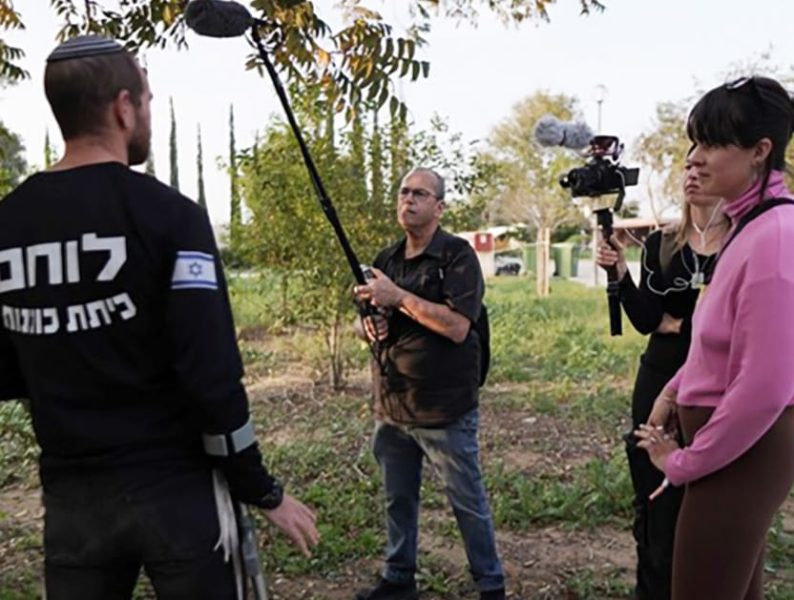
“The Holocaust taught us: Testimonies matter” – The Story of an October 7 Testimony Project
“It is a profound privilege to listen to someone tell their story. We live in a country where listening is not our strongest trait. But in the end, every one of us needs someone to listen.” – Just two days after the October 7 attacks, filmmaker and educator Itay Ken-Tor understood that the stories of the survivors needed to be documented. Together with friends, he founded Edut 710 (“Testimony 710”), an initiative that has already gathered more than 1,700 accounts. The team hopes to collect many more.
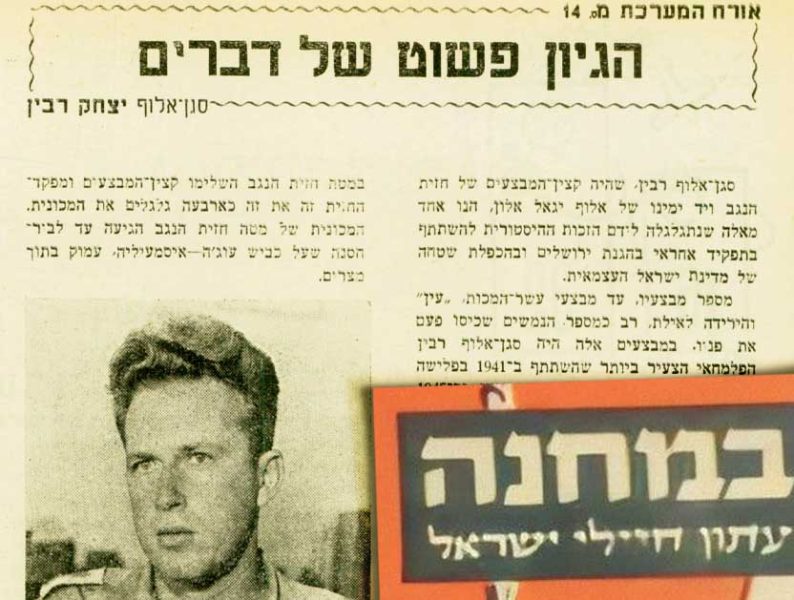
A Young Yitzhak Rabin Gives His First Interview
He was “level-headed, moderate, coolly analytical, with the lowest bass voice ever heard over the IDF’s combat radio,” and his “number of operations was as great as the number of freckles that once covered his face.” Lt. Col. Yitzhak Rabin gave his first interview to an army newspaper at the age of 27.

“They were witnesses to everything that happened”: Preserving Objects from October 7
After October 7, five women, three of them childhood friends, came together to found “Comfort Object”, an initiative that gives new life to items rescued from the destroyed homes of residents of Israel’s western Negev. Along the way, it has managed to offer a measure of hope to people who lost nearly everything. Among the salvaged items are a bench that survived a fire, a bullet-riddled armchair that served as a silent witness to the horrors, and the only object that remained from the home of the late Yossi Sharabi.

Michel Kichka Illustrates Our World
Great talent, optimism, sensitivity, compassion, and a deep love for this country, which he had longed to reach since childhood, all come together in Michel Kichka, making him one of Israel’s greatest graphic artists. We spoke with him about what led to the creation of his most personal graphic memoir, why he insists on keeping the family name “Kichka,” and what it was like working with Meir Shalev.
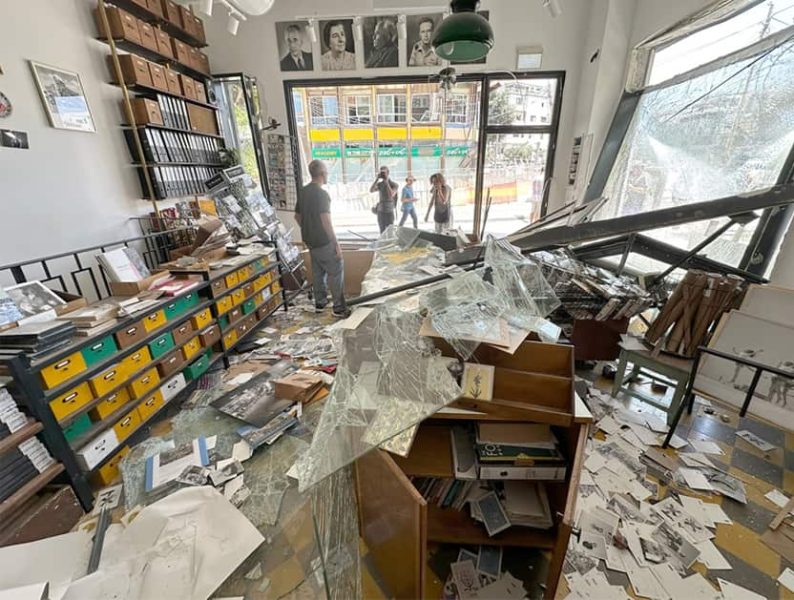
Saved From the Rubble: The Story of Israel’s PhotoHouse
The historic “PhotoHouse” shop on Allenby Street in Tel Aviv was severely damaged in a recent Iranian missile attack. But what exactly was the life’s work of photographer Rudi Weissenstein, and why does it hold a special place in so many hearts?