
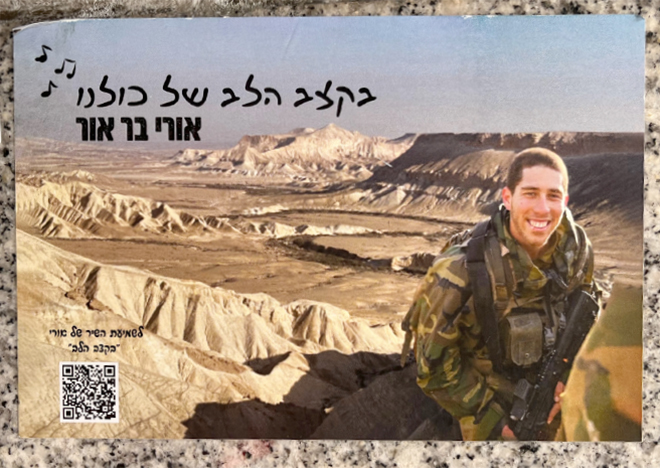
Many soldiers left behind words and slogans on the walls of Gaza, but only Uri Bar-Or left behind musical notes. Uri was a gifted composer, and unlike many of his peers who wrote rock or pop, he composed distinctive classical music infused with Mizrahi elements. So distinctive, that on his 18th birthday the Israeli Chamber Orchestra performed “Heartbeat,” a piece he wrote for 13 instruments, played by 51 musicians simultaneously.
In the final weeks of his life, through the nights in Gaza, he worked on his next major composition: a three-minute classical melody for each of the four seasons. He managed to finish three of them: “Autumn,” “Spring,” and “Winter”, as well as the first two minutes of “Summer.” The last minute remained unwritten.
He was killed that summer.
On 28 May 2024, the 20th of Iyar 5784, during a raid on an UNRWA clinic in Rafah, an explosive device planted in one of the rooms detonated, killing Uri and two other soldiers, Amir Galilov and Ido Appel, of blessed memory.

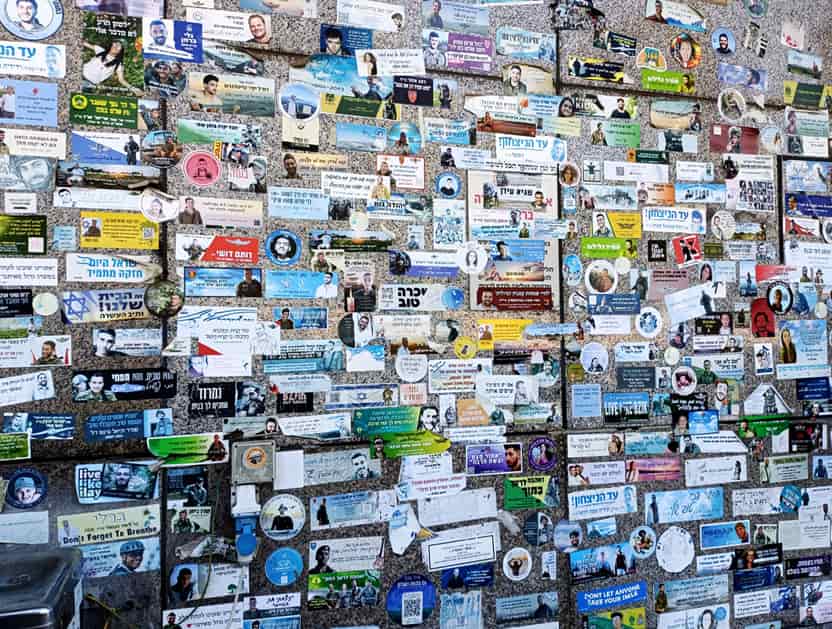
Uri is one of thousands whose smiling face now appears on memorial stickers pasted across the country.
“Uri’s sticker came into being already during the shiva,” recalls his father, Yaakov (Kobi) Bar-Or. “A boy whom Uri had taught guitar, who loved him very much, came and said, ‘Let’s make him a sticker.’ The sticker went through several versions, but the content was always the same: a picture of Uri against the desert landscape, the landscape of Sde Boker [a town in Israel’s southern Negev region]. That was his root, that’s where he came from. We added a QR code to the picture so that anyone who scans it reaches his composition, ‘Heartbeat.’ We believe his music is the best way to get to know him, much more than any phrase or slogan. The melody expresses Uri’s soul far more than anything we could write.”
Uri’s spirit can even be glimpsed in the WhatsApp status he posted at age 16:
“Why choose either this or that when you can have this and that.”
“There is something very profound in that,” his father explains, “because it doesn’t come from a place of rivalry or ego, of fighting over resources. The soul says ‘I want this and that’ – that love is not limited.” He adds: “Uri was both an artist, a composer, and also a very good soldier, an excellent soldier. He gave so much throughout his life, a very special child. Very curious and very creative, those were his most prominent qualities. And that’s it.”
Shouting Loss into the Trees and Stones
The phenomenon of memorial stickers did not originate with the events of October 7, explains Dr. Yael Netzer, lead scientist at the Center for Digital Humanities at the Hebrew University and a partner in “Edut 710,” one of the many initiatives established since the massacre to document and preserve what happened then and since. She notes that before October 7, the phenomenon was known mainly in Israeli backpacker culture. Discharged soldiers would take stickers commemorating fallen friends on their long post-army trips, pasting them on bus stops or guesthouses at various points around the world. The practice was familiar in academic circles, and a few articles had even been written about it as part of Israel’s sticker culture.
But after Simchat Torah of 2023, something changed.
“In the first week after the massacre, I went out and began documenting the war, and I started noticing the stickers for the Nova victims,” Netzer recounts. “I have the sense that the motivation of those who print and paste them is private commemoration, a personal need of the families, as if they are saying: ‘My child was killed, and you don’t even know it, because he is one of 1,200 people murdered that day.’” Netzer describes a kind of private outcry, an individual voice swallowed up in the immense disaster that befell the entire country. Many compared the first days after the massacre to the emotions stirred by the Holocaust: helplessness, the inability to grasp the small details when the vast numbers of victims overwhelm the names and the personal stories.
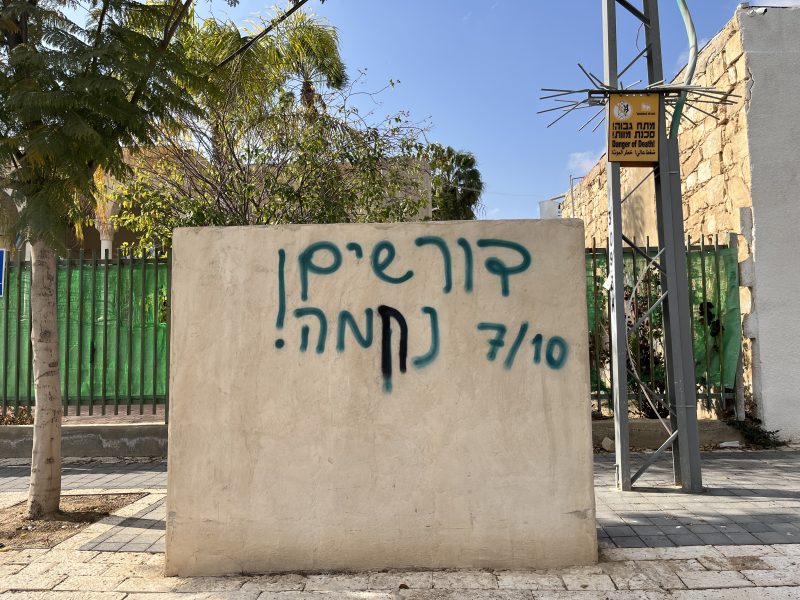
As part of her documentation work, Netzer established a website called “Walls of 7.10,” which records stickers, graffiti, and posters found in the streets, in shelters, and at the Nova site. She acted out of the understanding that public space shapes us, influences us in real time, and that once an event has passed, it can be difficult to reconstruct the contexts and feelings that public space once evoked.
The power and transience of public space, she says, can be seen in the coronavirus pandemic. Every store displayed instructions about wearing masks or using hand sanitizer, and at the time it seemed as though this reality would remain with us forever. Now it is hard to remember that our lives looked this way for several years. So too with the war, she explains: it creates a kind of “island in time” of bereavement and loss, in which the public space surrounding us on all sides expresses those emotions.
Netzer describes the development of a kind of “sticker tradition,” which retained similar yet distinct characteristics between the Nova victims and soldiers who fell in the line of duty. Nova victims were usually commemorated with phrases expressing a worldview of love, joy, music, and spirituality. The photograph of the victim was at the center, accompanied by words of longing. Gradually, the phenomenon of bereavement stickers expanded to include fallen soldiers. These often depict the soldier in uniform, together with military symbols, but the positive messages, the testaments they convey, remained in the same spirit, reflecting optimism, generosity, and sacrifice for the state and the collective.
A Conversation Between the Dead and the Living
The website Netzer runs is distinguished by meticulous attention to detail and allows for precise cross-referencing. Each sticker, for instance, is tagged with the location where it was photographed, along with a map and the name of the fallen. All documented stickers connected to that person are included, as well as the city they came from and the stickers of others from the same city.
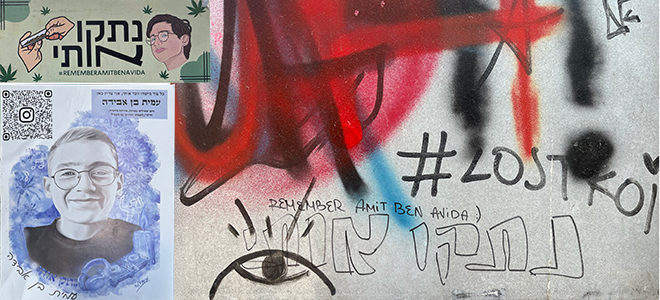
The matrix she created makes it possible to trace links and contexts between stickers and victims that would otherwise remain hidden. One example is the stickers commemorating Amit Ben Avida of Tel Aviv, murdered at the festival at only 19 years old. His stickers started off fairly conventionally, showing his photograph together with a phrase or an image of a broken heart. Over time, they evolved into designs bearing only the initials of his name, “A.B.A,” alongside references to inside jokes. “His friends are simply continuing to joke and laugh with him, among themselves, using private codes that only they understand. If you hadn’t seen the earlier stickers, you wouldn’t even know it was the same victim. That’s why context is essential to understanding the conversation,” Netzer explains.
The QR codes that often appear on the stickers are another link between bereavement and technology. They frequently lead to private memorial websites or Instagram pages, whether personal or collective, created to preserve the story of the fallen.
Walls of Mourning, Walls of Hope
It is impossible to pass through train stations across the country without stopping at the platform walls covered in stickers, walls that have become some of the largest spontaneous memorials in Israel.
“When I see other people’s stickers, I stop and read them,” says Kobi Bar-Or, father of the late Uri, describing the response shared by so many who pause before these vast walls filled with smiles that are no more. “I look at the faces of the soldiers, such beautiful faces, everything so pure and clean. It amazes me, a critical mass of good people who are ‘there’ in order to help us here. So I look at the faces and see the goodness, the beauty, the strength.”
The creation of these memorial walls was, to a large extent, coincidental, depending on whether a station manager chose to allow it, to set aside a designated space for the stickers, or to try to scrape them away.
“There are certain popular spots for stickers,” says Netzer, noting that the Hebrew University has also created dedicated areas for them. “There are well-known places for posting memorial stickers, like in the Gaza border region, in shelters, and at the Nova site. But the reach of the stickers is worldwide. I’ve seen them in Italy, in New York, everywhere.”
In fact, stickers have altered the very way we commemorate the fallen, spreading gradually even to those not connected to the Nova festival or to the war. Look closely and you may see stickers for people killed in traffic accidents, including abroad, and even one, whose name Netzer did not mention, apparently killed in criminal activity.
From time to time, stickers for those who fell in earlier years also appear on the walls of mourning: victims of the 1997 Israeli helicopter disaster or of the First and Second Lebanon Wars. “I have a photo of a sticker at the HaHagana train station for a Holocaust survivor who was killed in the War of Independence, the last surviving member of his family. There’s something subversive about it, as if everything lies on the same continuum,” Netzer tells us.
“Stickers have changed the culture of bereavement in Israel,” she says. “You’re expected to make a sticker. If you don’t, it raises questions: what, you didn’t love the fallen?”
Stickers for Future Generations
“When I see a sticker that I pasted, it makes me happy. I enjoy coming back to it,” says Kobi Bar-Or. In recent months, the Bar-Or family has received responses from around the world to “Heartbeat,” the composition Uri wrote. People in many countries have listened to his music and been moved by it, even though they never knew him, some thanks to the QR code printed on the sticker. Uri’s stickers too have traveled farther than Kobi ever imagined. “If it’s a sticker I didn’t paste myself but suddenly come across as if from nowhere, it’s something incredible. Sometimes we’re driving along the road and spot a car with a sticker of our son. It’s simply incredible, it moves us so deeply. Not just a little, but very much.”
The National Library has now launched a new project to collect the stickers and eulogies created in memory of the fallen. It is part of the Library’s broader initiative to establish an archive documenting the events of October 7. One of its goals is to preserve these stickers and eulogies so that they remain accessible for future generations, long after weather and time erase them from the public space. The project seeks to collect the digital files used to print the stickers, but photographs and printed stickers may also be submitted.
Maya Gan-Zvi, director of the Bearing Witness Archive documenting the events of October 7 and the war at the National Library, describes the importance of this effort: “This is a form of civic commemoration, spontaneous, mobile monuments or non-monuments, that spread the memory of the fallen and the murdered throughout the world. It is our responsibility to document them and to create the comprehensive historical record in an archive that will remain available to us and to generations to come.”
We invite you to submit stickers and eulogies commemorating the fallen and the murdered to the National Library, to become part of the larger story of the Jewish People, and to help preserve the memory of those who once were and are no more. For more details and to submit, click here.